By the Numbers
- STATAccording to Energy Rating Australia, air conditioners account for approximately 23% of household electricity consumption in NSW, making operational efficiency critical during Sydney’s summer months when ambient temperatures regularly exceed 30°C.
- STATAIRAH technical data indicates that dirty air filters can reduce HVAC system efficiency by 15-25% and increase compressor runtime by up to 30%, accelerating wear on mechanical components and refrigerant circuit seals.
- STATThe Australian Refrigeration Council reports that approximately 18% of residential AC service calls in Sydney involve refrigerant leaks, with R410A systems operating at 2.76 MPa (400 psi) high-side pressure requiring ARC Tick certified technicians for legal repairs.
- STATStandards Australia AS/NZS 3666.2:2011 specifies that condensate drainage systems must maintain minimum 1:100 fall gradient, and blocked drains cause 32% of water leak complaints in ducted and split system installations across Sydney’s residential sector.
When your air conditioner stops working during Sydney’s humid summer months, the discomfort arrives quickly. Understanding whether your AC not working issue requires immediate professional intervention or simple homeowner troubleshooting can save both time and money. This complete troubleshooting guide for AC failures addresses the most common failure scenarios encountered in Sydney’s Cfa climate classification, where sustained temperatures above 30°C and high humidity levels place exceptional demands on refrigerant systems.
Over 25 years servicing Sydney’s residential and commercial properties, Vital Air Conditioning has documented that approximately 70% of AC failures require licensed technician intervention due to refrigerant handling requirements under the Ozone Protection and Synthetic Greenhouse Gas Management Act 1989, electrical work governed by AS/NZS 3000:2018 (Australian/New Zealand Wiring Rules), or pressure testing per AS/NZS 5149.1:2016 (Refrigerating systems—Safety requirements). The remaining 30% involve homeowner-accessible diagnostics including filter maintenance, thermostat verification, and basic power supply checks.
Common Reasons Your AC Stops Working in Sydney’s Climate
Sydney’s humid subtropical climate creates specific failure patterns not commonly seen in drier inland regions. Coastal humidity accelerates condensate accumulation, promoting algae growth in drain lines and accelerating corrosion on aluminium evaporator fins. Salt-laden air in Eastern Suburbs installations corrodes copper refrigerant lines and condenser coils within 8-12 years without proper maintenance. Summer peak demand periods stress compressor capacitors and contactors, while thermal expansion cycles fatigue refrigerant circuit brazed joints.
Understanding these climate-specific stressors helps identify whether your system requires filter cleaning, thermostat adjustment, or immediate professional assessment. The following sections distinguish between safe homeowner diagnostics and work requiring ARC Tick certification and electrical licensing.
Power Supply Issues: Circuit Breakers and Electrical Faults
Complete system failure typically indicates electrical supply interruption. Check your switchboard for tripped circuit breakers or residual current devices (RCDs) protecting the air conditioning circuit. Under AS/NZS 3000:2018, air conditioners must have dedicated overcurrent protection rated to the unit’s maximum current draw plus 25% safety margin. A 3.5 kW split system typically requires a 20-amp circuit breaker.
If you discover a tripped breaker, reset it once only. Successful reset with normal operation suggests a temporary voltage spike or brief overload condition. Immediate re-tripping indicates serious electrical faults including compressor winding short circuits, capacitor failure causing overcurrent draw, or earth leakage exceeding the 30mA threshold that triggers RCD protection. These conditions present fire risks and require immediate assessment by a licensed electrician before restoring power.
For detailed guidance on reasons your AC won’t turn on at all, including control circuit failures and safety switch activation, refer to our comprehensive power supply diagnostic guide. Understanding why your air conditioner keeps tripping the circuit breaker helps identify whether the fault lies in the AC unit itself or the building’s electrical infrastructure.
Warning:
Blocked or Dirty Air Filters Restricting Airflow
Restricted airflow from blocked filters represents the most common homeowner-serviceable AC failure. AIRAH technical data indicates that dirty air filters can reduce HVAC system efficiency by 15-25% and increase compressor runtime by up to 30%, accelerating wear on mechanical components and refrigerant circuit seals. In Sydney’s humid climate, filters accumulate dust, pollen, and moisture that promotes mould growth within 4-6 weeks during peak cooling season.
Split system return air filters require removal and cleaning every 4-6 weeks. Remove the front panel, slide out the mesh filter, and wash under running water. Allow complete drying before reinstallation—wet filters restrict airflow and promote microbial growth. Ducted systems use disposable pleated filters rated by MERV (Minimum Efficiency Reporting Value) that require replacement rather than cleaning. AS/NZS 3666.1:2011 (Air-handling and water systems of buildings—Microbial control) specifies filter maintenance schedules based on occupancy and environmental conditions.
Severely blocked filters cause evaporator coil icing as reduced airflow prevents adequate heat exchange. The coil temperature drops below freezing, causing condensate to freeze on aluminium fins. This ice buildup further restricts airflow, creating a cascading failure that eventually triggers low-pressure cutout switches. For detailed proper filter maintenance procedures, including MERV rating selection and cleaning frequency recommendations, consult our comprehensive filter maintenance guide.
Thermostat Malfunctions and Incorrect Settings
Thermostat issues account for approximately 15% of “AC not working” service calls where the system itself functions correctly. Modern digital thermostats require battery replacement every 12-18 months. Dead batteries prevent the thermostat from sending control signals to the indoor unit, resulting in complete system non-operation despite adequate power supply.
Verify the thermostat displays correctly and shows the current room temperature. Set the mode to “COOL” and adjust the temperature setpoint 2-3°C below current room temperature to trigger cooling operation. Many thermostats include programmable schedules that may inadvertently disable cooling during occupied periods. Check for “HOLD,” “OVERRIDE,” or “SCHEDULE” indicators that may prevent manual operation.
Wireless thermostats lose communication with indoor units due to interference from WiFi routers, cordless phones, or physical obstructions. Re-pairing the remote typically involves pressing specific button combinations detailed in the manufacturer’s manual. Infrared remote controls require clear line-of-sight to the indoor unit receiver—furniture placement or wall art can block the signal path.
Refrigerant Leaks and Low Gas Pressure
Refrigerant loss represents a serious failure requiring immediate professional intervention. The Australian Refrigeration Council reports that approximately 18% of residential AC service calls in Sydney involve refrigerant leaks, with R410A systems operating at 2.76 MPa (400 psi) high-side pressure requiring ARC Tick certified technicians for legal repairs. Common leak points include brazed joints on refrigerant lines, service port valve cores, and evaporator coil tube-to-header connections that fatigue under thermal cycling.
Signs of refrigerant loss include reduced cooling capacity, longer run times to reach setpoint temperature, ice formation on suction line insulation, and hissing sounds near refrigerant connections. R32 refrigerant (used in newer high-efficiency systems) and R410A both operate as near-azeotropic blends that must be charged as liquid rather than vapour to maintain correct composition ratios.
Under the Ozone Protection and Synthetic Greenhouse Gas Management Act 1989, only technicians holding current ARC Tick certification (Refrigerant Handling Licence) can legally purchase, handle, or recover refrigerants. DIY refrigerant work carries penalties up to $13,320 for individuals. Pressure testing per AS/NZS 5149.1:2016 requires nitrogen pressurisation to 150% of design pressure for leak detection—procedures beyond homeowner capability and safety. For comprehensive information on refrigerant leak detection and repair requirements, including environmental obligations and proper recovery procedures, refer to our detailed technical guide.
Warning:
Condensate Drain Blockages Causing Water Leaks
Sydney’s humid climate generates substantial condensate during cooling operation—a typical 5 kW split system produces 1-2 litres per hour at 32°C ambient temperature and 65% relative humidity. AS/NZS 3666.2:2011 (Air-handling and water systems of buildings—Microbial control—Operation and maintenance) specifies that condensate drainage systems must maintain minimum 1:100 fall gradient to ensure gravity drainage without standing water that promotes algae and bacterial growth.
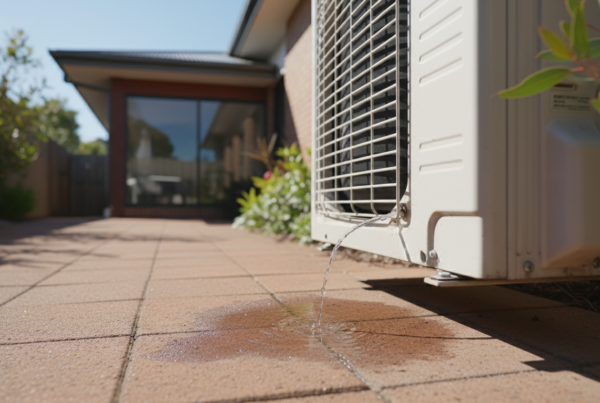
Blocked condensate drains cause 32% of water leak complaints in Sydney installations. Algae grows in the drain pan and PVC drain line, forming gelatinous blockages that prevent drainage. Water backs up into the drain pan, triggering float switch safety cutouts that shut down the system. In installations without float switches, water overflows from the indoor unit, causing ceiling damage and promoting mould growth in building cavities.
Homeowners can inspect the external drain outlet for water flow during system operation. Clear visible blockages from the drain pan using a wet-dry vacuum. More severe blockages within the drain line require professional clearing using compressed air or specialised drain cleaning equipment. For comprehensive guidance on diagnosing and fixing water leaks from your AC, including drain pan inspection procedures and preventative treatments, consult our detailed water leak diagnostic guide.
Frozen Evaporator Coils: Causes and Prevention
Ice formation on evaporator coils indicates inadequate heat exchange causing coil surface temperature to drop below 0°C. Multiple factors contribute to coil icing including restricted airflow from dirty filters, low refrigerant charge reducing evaporator pressure, failed blower motors reducing air velocity across coil fins, and outdoor operation below 18°C ambient temperature where heat pumps struggle to maintain adequate evaporator superheat.
Visible ice on the indoor unit’s aluminium fins requires immediate system shutdown to prevent compressor damage from liquid refrigerant flooding back through the suction line. Turn the system off and allow 2-3 hours for complete ice melting. During this period, inspect and clean air filters, verify all supply registers remain open, and check that furniture or curtains don’t block return air grilles.
If coil icing recurs after filter cleaning and adequate defrost time, the issue likely involves refrigerant undercharge or failed blower motor capacitors—both requiring professional diagnosis. Blower motor capacitors typically rated between 2.5-7.5 microfarads (μF) depending on motor size can fail partially, reducing motor speed without complete failure. This reduced airflow isn’t immediately obvious but causes progressive coil icing over 20-30 minutes of operation.
Compressor Failures and Capacitor Problems
Compressor failure represents the most expensive AC repair, often approaching 60-70% of complete system replacement cost. Scroll compressors used in modern residential systems typically achieve 60,000-80,000 operating hours under normal conditions, but premature failure occurs from refrigerant contamination, liquid slugging from evaporator flooding, or electrical issues including single-phasing on three-phase commercial units.
Start capacitors and run capacitors enable compressor motor startup and maintain efficient operation. These cylindrical components mounted near the compressor or inside the outdoor unit electrical compartment fail from voltage spikes, thermal stress, and age-related dielectric breakdown. Failed start capacitors prevent compressor startup—the unit hums briefly then shuts down on thermal overload protection. Failed run capacitors allow startup but cause inefficient operation, overheating, and eventual compressor winding damage.
Capacitor testing requires discharge procedures and multimeter measurement of microfarad ratings—work requiring electrical qualification. Capacitors store lethal voltage even after power disconnection. Visual inspection may reveal bulging cases or leaked dielectric fluid indicating failure, but many failed capacitors show no external damage. Given the electrical hazards and diagnostic equipment requirements, capacitor replacement falls within the professional service domain rather than homeowner maintenance.
When to Call a Licensed Technician Instead of DIY
Clear boundaries separate homeowner-safe diagnostics from work requiring professional licensing. Filter cleaning, thermostat battery replacement, circuit breaker inspection, and basic condensate drain clearing represent appropriate homeowner maintenance. Everything involving refrigerant circuits, electrical component replacement, or pressure testing requires licensed technicians.
Call a professional immediately when you observe refrigerant odours (sweet, ether-like smell), hear grinding or metal-on-metal sounds from the compressor, see oil residue around refrigerant connections indicating leak points, or experience repeated circuit breaker tripping. These symptoms indicate failures beyond homeowner capability and potential safety hazards.
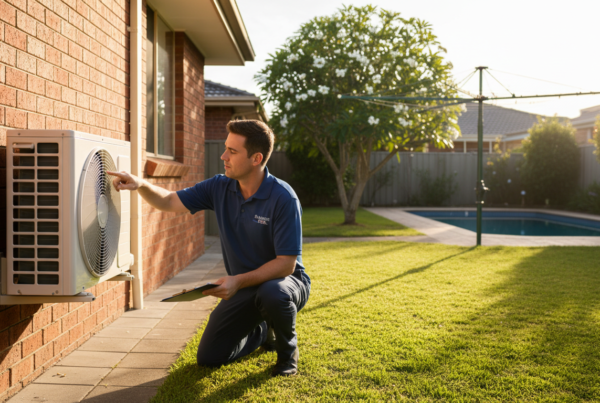
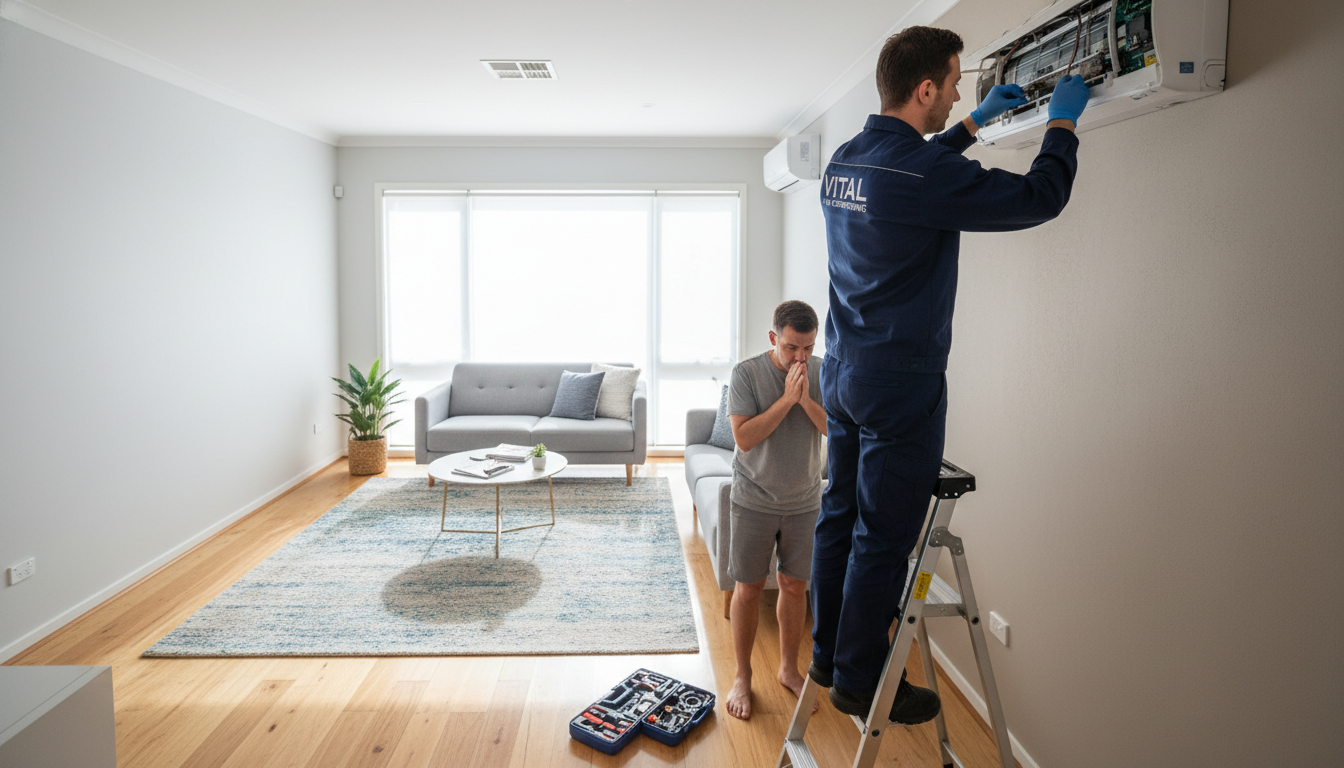
Vital Air Conditioning’s ARC Tick certified technicians carry refrigerant recovery equipment, pressure testing apparatus, and electrical diagnostic tools required for comprehensive AC repair across Sydney Metro, Hills District, Eastern Suburbs, and Inner West service areas. Our 24/7 emergency availability addresses urgent cooling failures during Sydney’s peak summer heat when indoor temperatures become hazardous for vulnerable occupants. For detailed information on signs your system needs immediate professional attention, including unusual noises, odours, and performance degradation patterns, consult our professional service indicators guide.
Preventative Maintenance to Avoid Future Breakdowns
Scheduled maintenance dramatically reduces unexpected AC failures. Annual professional servicing per AS/NZS 3666.2:2011 includes refrigerant pressure verification, electrical connection tightening, condensate drain treatment, coil cleaning, and capacitor testing. These procedures identify developing issues before complete failure occurs.
Between professional services, homeowners should implement basic maintenance protocols. The following checklist covers essential homeowner-accessible maintenance tasks that extend system life and maintain efficiency.
- ✓
Check thermostat display for error codes and verify mode is set to ‘COOL’ with temperature set 2-3°C below current room temperature - ✓
Inspect switchboard for tripped circuit breakers or safety switches and reset once only—repeated tripping requires electrician assessment - ✓
Remove and clean return air filters under running water, allow to dry completely before reinstalling (split systems) or replace disposable filters (ducted systems) - ✓
Verify outdoor condenser unit fan is spinning and clear debris within 500mm radius per AS/NZS 60335.2.40 clearance requirements - ✓
Check indoor unit for ice formation on evaporator coils—if present, turn system off for 2-3 hours to allow complete defrost - ✓
Inspect condensate drain outlet for water flow during operation and clear visible blockages from drain pan and PVC drain line - ✓
Test remote control batteries and ensure infrared signal reaches indoor unit receiver without obstructions - ✓
Document any unusual noises (grinding, squealing, clicking) and refrigerant odours for technician diagnosis if DIY checks fail
Equipment Energy Efficiency (E3) Program minimum performance standards mandate minimum SEER (Seasonal Energy Efficiency Ratio) ratings for new installations. Systems manufactured before 2010 typically achieve SEER ratings of 3.0-3.5, while current high-efficiency models reach SEER 6.0-7.0. When repair costs exceed 50% of replacement cost, or the system age exceeds 12-15 years, replacement with high-efficiency equipment provides better long-term value through reduced operating costs. According to Energy Rating Australia, air conditioners account for approximately 23% of household electricity consumption in NSW—upgrading from a 3.0 SEER unit to a 6.0 SEER model reduces cooling energy consumption by approximately 50%.
Vital Air Conditioning has diagnosed and repaired AC failures across Sydney for over 25 years. Our ARC Tick licensed technicians provide same-day service with a comprehensive 5-year warranty on all repairs and installations.
Frequently Asked Questions
Why is my air conditioner not turning on at all?
Complete AC failure typically indicates power supply issues—check your switchboard for tripped circuit breakers or safety switches first. Under AS/NZS 3000:2018 (Australian/New Zealand Wiring Rules), air conditioning circuits must have dedicated overcurrent protection, and repeated tripping indicates electrical faults requiring a licensed electrician. Thermostat battery failure or incorrect mode settings can also prevent startup.
Can I fix a refrigerant leak in my air conditioner myself?
No—refrigerant handling in Australia requires an ARC Tick licence (Refrigerant Handling Licence) issued under the Ozone Protection and Synthetic Greenhouse Gas Management Act 1989. AS/NZS 5149.1:2016 (Refrigerating systems—Safety requirements) mandates that only licensed technicians can purchase, handle, or recover refrigerants including R32, R410A, and R134a. DIY refrigerant work is illegal and carries penalties up to $13,320 for individuals.
How often should I clean my air conditioner filters?
AIRAH (Australian Institute of Refrigeration, Air Conditioning and Heating) recommends cleaning or replacing filters every 4-6 weeks during peak cooling season in Sydney’s humid subtropical climate. AS/NZS 3666.1:2011 (Air-handling and water systems of buildings—Microbial control) specifies that blocked filters reduce airflow by up to 15%, increasing energy consumption and promoting microbial growth. Split system return air filters should be vacuumed fortnightly during summer use.
What does it mean when my AC is running but not cooling?
An AC running without cooling typically indicates refrigerant loss, frozen evaporator coils, or compressor failure. Check for ice buildup on indoor coil fins—this suggests restricted airflow from dirty filters or low refrigerant charge. Outdoor condenser units must maintain minimum clearances per AS/NZS 60335.2.40:2015 (Safety of household appliances—Air conditioners) for adequate heat rejection, and blocked condenser coils reduce cooling capacity by 20-30%.
Is it safe to reset my air conditioner circuit breaker multiple times?
No—repeated circuit breaker tripping indicates overcurrent conditions that pose fire risks under AS/NZS 3000:2018 electrical safety requirements. Common causes include compressor short-cycling, capacitor failure, or earth leakage exceeding 30mA residual current device (RCD) thresholds. After one reset attempt, persistent tripping requires immediate assessment by a licensed electrician to identify electrical faults, damaged wiring, or failing compressor windings before restoring power.