By the Numbers
- STATAccording to the Australian Institute of Refrigeration, Air Conditioning and Heating (AIRAH), blocked condensate drains account for 34% of all residential air conditioning service calls during summer months across NSW.
- STATEnergy Rating Australia data indicates that restricted airflow from dirty filters can reduce system efficiency by 15-25% while simultaneously causing evaporator coil temperatures to drop 8-12°C below design specifications, triggering freeze conditions.
- STATThe Australian Refrigeration Council reports that approximately 18,000 refrigerant handling incidents are investigated annually, with improper charging contributing to low-pressure freeze-ups that cause water leakage when ice melts.
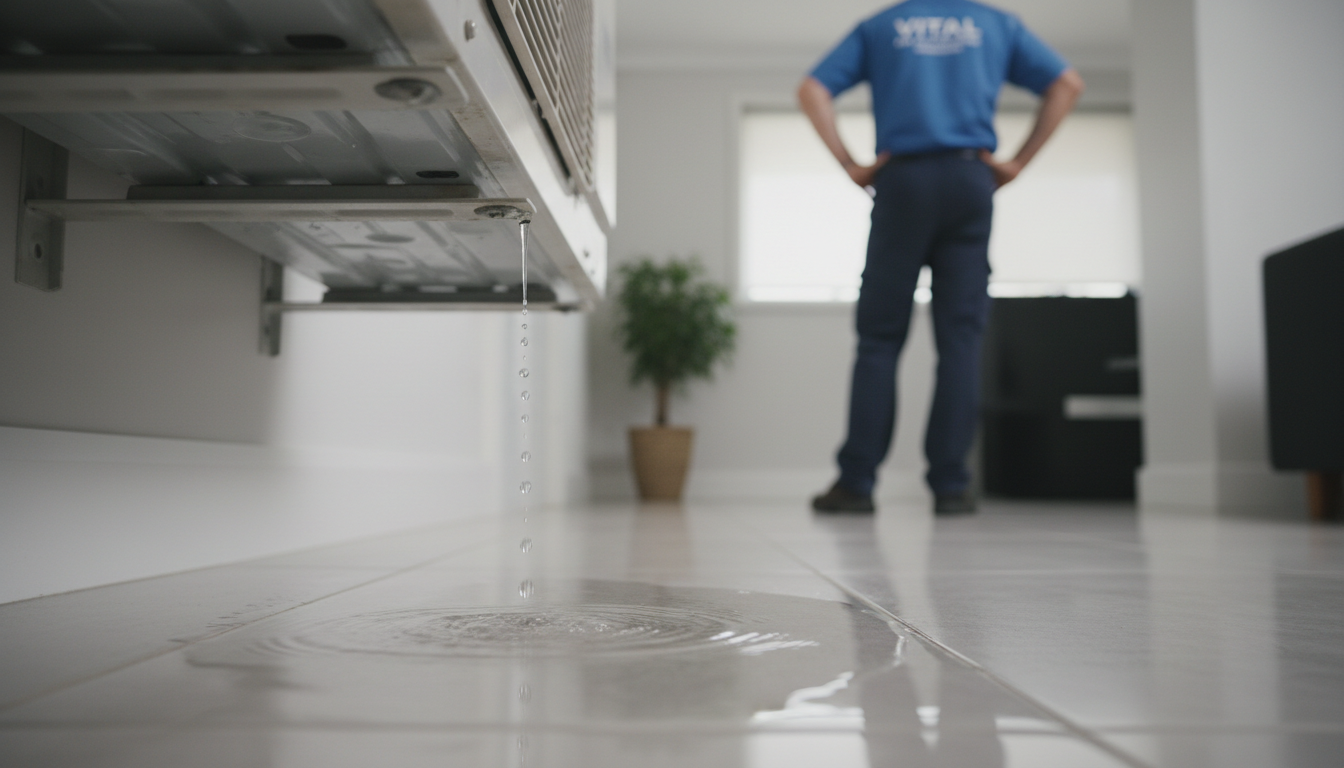
Finding water pooling beneath your indoor unit or dripping from ceiling vents indicates your air conditioner leaking water internally, a fault that requires immediate diagnosis to prevent structural damage and mould growth. While outdoor condensate discharge is normal thermodynamic operation, any indoor leakage signals system malfunction requiring attention under AS/NZS 3823.2:2013 (Performance of Electrical Appliances – Air Conditioners and Heat Pumps). Understanding the specific cause determines whether you need simple maintenance or licensed technician intervention.
During Sydney’s humid summer months, a typical 7kW split system produces between 5 and 20 litres of condensate daily as the evaporator coil removes moisture from indoor air. This water must drain completely through properly installed and maintained condensate lines. When drainage fails or ice formation overwhelms the system, water escapes into your home rather than discharging safely outdoors.
Why Is My Air Conditioner Leaking Water Inside?
Indoor water leakage always indicates malfunction in one of four critical systems: condensate drainage, airflow management, refrigerant circuit operation, or structural integrity of water-handling components. Each cause produces distinct symptoms that help diagnose the underlying fault.
The evaporator coil inside your air handler operates at temperatures typically 7-10°C above the dewpoint of incoming air. As warm, humid air passes across these cold coils, moisture condenses at rates directly proportional to ambient humidity levels. According to the Australian Institute of Refrigeration, Air Conditioning and Heating (AIRAH), blocked condensate drains account for 34% of all residential air conditioning service calls during summer months across NSW, making drainage faults the single most common cause of indoor leaking.
Vital Air Conditioning has diagnosed and repaired thousands of condensate-related faults across Sydney Metro, Hills District, Eastern Suburbs, and Inner West over our 25 years of operation. The diagnostic process begins by identifying which component has failed within the water management system.
Blocked or Disconnected Condensate Drain Line
The condensate drain line carries water from the indoor unit drain pan to an external discharge point, typically through 20mm PVC pipe installed with minimum 25mm fall per metre as specified in AS/NZS 3500.3:2018 (Plumbing and Drainage – Stormwater Drainage). Blockages develop from algae growth, dust accumulation, insect nests, or debris entering through inadequate termination points.
When drain lines block completely, water backs up into the drain pan until it overflows. Partial blockages cause intermittent leaking that worsens during high-humidity periods when condensate production peaks. A 7kW split system generates 1-2 litres per hour at 50% humidity but 3-4 litres per hour above 70% humidity, overwhelming marginally blocked drains during Sydney’s humid summer conditions.
Disconnected drain lines present immediately as continuous leaking from the moment the system begins cooling. Installation faults, vibration over time, or improper service work can separate drain connections at the unit or along the pipe run. Understanding how condensate drain systems work helps identify whether blockage or disconnection causes your specific leak pattern.
Homeowners can inspect accessible drain line termination points for blockages and clear visible obstructions using a wet-dry vacuum applied to the external drain outlet. However, internal blockages within wall cavities or ceiling spaces require professional drain line flushing equipment and may necessitate drain line replacement if algae growth has become established throughout the pipe length.
Dirty or Clogged Air Filters Restricting Airflow
Air filters protect the evaporator coil from dust accumulation while maintaining design airflow rates specified in AS/NZS 3823.1.2:2013 (Performance of Electrical Appliances – Air Conditioners and Heat Pumps – Ducted Air Conditioners and Air-to-Air Heat Pumps – Testing and Rating for Performance). Energy Rating Australia data indicates that restricted airflow from dirty filters can reduce system efficiency by 15-25% while simultaneously causing evaporator coil temperatures to drop 8-12°C below design specifications, triggering freeze conditions.
When airflow drops below minimum requirements, the evaporator coil cannot absorb sufficient heat from passing air. Coil temperature drops below 0°C, causing moisture to freeze on coil surfaces rather than draining as liquid water. Ice accumulation continues until the system cycles off or safety controls activate. During the defrost cycle or when the system remains off, accumulated ice melts rapidly, producing water volume that exceeds drain pan capacity and causes overflow leaking.
Filter inspection requires no tools and takes less than two minutes. Remove the filter from the indoor unit or return air grille and hold it toward a light source. If light transmission is significantly reduced or dust coating exceeds 2mm thickness, the filter requires cleaning or replacement. Following proper filter maintenance procedures prevents the majority of airflow-related freeze-ups and subsequent water leakage.
Washable filters should be cleaned every 4-6 weeks during cooling season using mild detergent and water, then dried completely before reinstallation. Disposable filters require replacement at the same interval. Never operate the system without filters installed, as unfiltered air rapidly coats evaporator fins with dust, creating the same airflow restriction while also reducing heat transfer efficiency.
Frozen Evaporator Coil Causing Ice Melt
Beyond filter blockages, evaporator coil freezing results from refrigerant pressure imbalances, failed blower motors, closed or blocked supply vents, or extremely low ambient temperatures during cooling operation. The evaporator coil must maintain surface temperatures above freezing while operating at pressures typically between 450-650 kPa for R410A refrigerant systems under normal load conditions.
When suction pressure drops below approximately 350 kPa, coil temperature falls below 0°C and ice formation begins. This pressure drop occurs from refrigerant undercharging, restriction in the refrigerant circuit, or excessive heat load reduction from airflow blockage. Ice initially forms on the coldest coil sections, then spreads across the entire coil surface as the condition persists.
Visible symptoms include reduced airflow from supply vents, warm air discharge despite the system running continuously, and ice visible on refrigerant lines or around the indoor unit. When ice melts, water volume can reach several litres, overwhelming drain pan capacity designed for normal condensate rates. The relationship between freeze-ups and leaking is detailed in our guide on preventing evaporator coil freeze-ups.
Warning:
Frozen coil diagnosis requires refrigerant pressure measurement, superheat and subcooling calculations, and airflow verification using calibrated instruments. These procedures fall outside homeowner capabilities and require professional assessment to identify whether refrigerant loss, metering device failure, or airflow restriction causes the freeze condition.
Damaged or Rusted Drain Pan
The drain pan beneath the evaporator coil collects condensate and channels it toward the drain connection. Drain pans in systems over 10 years old commonly develop rust perforation in steel pans or crack formation in plastic pans, allowing water to drip directly onto ceilings or through the unit casing rather than flowing to the drain outlet.
Drain pan inspection requires removing the indoor unit cover and examining the pan surface with a torch for rust spots, cracks, or standing water that should have drained. Rust typically develops at pan seams or where condensate remains in contact with metal surfaces for extended periods. Plastic pans crack from thermal stress cycles or impact damage during previous service work.
Secondary drain pans installed beneath the primary pan provide backup protection in ceiling-mounted units, preventing water damage when primary pans fail. AS/NZS 3823.2:2013 does not mandate secondary pans for all installations, but they represent best practice for units installed above finished ceilings where leak damage costs significantly exceed secondary pan installation expense.
Drain pan replacement requires refrigerant recovery, indoor unit disassembly, and proper reinstallation with correct drainage fall. This work must be performed by an ARC Tick licensed technician due to refrigerant handling requirements. Temporary sealants or patches provide unreliable repairs that typically fail within months, necessitating proper pan replacement for permanent leak resolution.
Low Refrigerant Levels and Pressure Imbalances
Refrigerant undercharging reduces evaporator pressure below design specifications, lowering coil operating temperature and triggering freeze conditions identical to those caused by airflow restriction. The Australian Refrigeration Council reports that approximately 18,000 refrigerant handling incidents are investigated annually, with improper charging contributing to low-pressure freeze-ups that cause water leakage when ice melts.
Refrigerant loss occurs through leak development at flare connections, brazed joints, valve cores, or coil perforation from corrosion or mechanical damage. Systems do not consume refrigerant during normal operation. Any system requiring refrigerant addition has a leak that must be located and repaired to prevent recurring loss and continued system damage.
Low refrigerant symptoms include inadequate cooling capacity, ice formation on the suction line near the outdoor unit, extended run times, and higher than normal electricity consumption as the compressor works harder attempting to achieve setpoint temperature. Refrigerant pressure measurement requires manifold gauges and knowledge of pressure-temperature relationships for the specific refrigerant type.
All refrigerant work requires ARC Tick certification under the Ozone Protection and Synthetic Greenhouse Gas Management Act 1989. Unlicensed refrigerant handling carries penalties up to $13,320 for individuals and $66,600 for companies. Licensed technicians use electronic leak detectors, pressure testing, and proper recovery equipment to locate leaks, repair them permanently, evacuate the system to remove moisture and air, then recharge to manufacturer specifications using refrigerant scales accurate to 10 grams.
Incorrect Installation or Improper Unit Levelling
Indoor units must be installed level or with slight backward tilt toward the drain connection to ensure condensate flows completely from the drain pan. Units tilted forward or severely out of level allow water to pool in the pan front section, eventually overflowing the pan lip rather than draining properly.
Installation standards in AS/NZS 3823.2:2013 specify maximum deviation from level, typically 5mm across the unit width. Wall-mounted split systems require secure bracket installation to prevent settling over time. Ducted units in ceiling spaces must be supported on level platforms or suspended from correctly adjusted threaded rods.
Checking unit level requires a spirit level placed on the indoor unit casing or drain pan surface. Units found out of level require bracket adjustment for wall-mounted systems or platform relevelling for ducted installations. This work involves structural considerations and electrical disconnection, making it appropriate for professional service rather than homeowner adjustment.
Vibration from unbalanced blower wheels or loose mounting can gradually shift unit position over months or years. Annual inspections should verify level remains within specification and mounting hardware remains tight. Vital Air Conditioning includes level verification in our standard maintenance procedures, catching installation drift before it causes drainage problems.
When to Call a Licensed Technician
Homeowners can safely perform filter cleaning, accessible drain line clearing, and basic visual inspections. However, several conditions require immediate professional assessment to prevent equipment damage or safety hazards.
Recognizing these signs your system needs immediate professional attention prevents minor leaks from escalating into major water damage or complete system failure. ARC Tick licensed technicians carry calibrated diagnostic equipment, refrigerant handling tools, and manufacturer-specific technical documentation unavailable to homeowners.
Emergency situations requiring same-day service include continuous heavy leaking causing ceiling damage, electrical components exposed to water creating shock hazards, or complete system failure during extreme temperature periods. Vital Air Conditioning provides 24/7 emergency service across Sydney Metro for urgent leak repairs that cannot wait for standard business hours.
How to Temporarily Stop an Air Conditioner Leak
When leaking begins outside business hours or before scheduled service, temporary measures minimize water damage while awaiting professional repair. These steps address symptoms only and do not resolve underlying faults requiring licensed technician diagnosis.
- 1
Turn the system off immediatelyPower off at the thermostat and circuit breaker to stop condensate production and prevent electrical hazards from water contact with live components.
- 2
Contain the waterPlace towels, buckets, or plastic sheeting beneath the leak source to protect flooring, ceilings, and furnishings from water damage and mould development.
- 3
Inspect and clean the air filterRemove the filter and clean thoroughly if dirty. A clogged filter may be the sole cause of freeze-up leaking, and cleaning it may resolve the issue without further intervention.
- 4
Check the external drain line outletLocate where the condensate drain discharges outside and verify water flows freely when you pour 500ml water into the indoor unit drain pan access point.
- 5
Document the leak patternNote when leaking occurs, approximate volume, whether ice was visible, and any unusual sounds or performance issues to provide accurate diagnostic information to the service technician.
Our detailed step-by-step guide to stopping water leaks provides additional emergency procedures for specific leak scenarios. These temporary measures never substitute for professional diagnosis and repair of the underlying fault causing water leakage.
Preventing Future Water Leaks Through Regular Maintenance
Systematic preventative maintenance eliminates the majority of condensate drainage faults before they cause indoor water leakage. The importance of scheduled preventative maintenance extends beyond leak prevention to include energy efficiency, system longevity, and indoor air quality benefits.
Annual professional maintenance by ARC Tick licensed technicians should include drain line flushing with biocide treatment to prevent algae growth, drain pan inspection and cleaning, refrigerant pressure verification, airflow measurement, and electrical component testing. These procedures identify developing faults before they cause system failure or water damage.
- ✓
Inspect the condensate drain line outlet monthly for blockages, algae growth, or disconnection - ✓
Replace or clean air filters every 4-6 weeks during cooling season per manufacturer specifications - ✓
Check indoor unit drain pan for rust, cracks, or standing water accumulation - ✓
Verify outdoor unit is level within 5mm using a spirit level to ensure proper drainage - ✓
Examine visible refrigerant line insulation for damage that could cause condensation dripping - ✓
Test drain line flow by pouring 500ml water into drain pan to confirm unobstructed drainage - ✓
Schedule annual preventative maintenance with an ARC Tick licensed technician before summer - ✓
Document leak location, frequency, and volume to provide accurate information to service technicians
Homeowner maintenance tasks complement but never replace professional service. Filter cleaning and drain outlet inspection take minimal time but prevent the majority of airflow and drainage faults. However, internal component inspection, refrigerant circuit testing, and electrical diagnostics require specialized equipment and training available only to licensed technicians.
Understanding other common air conditioning faults helps identify developing issues before they cause system failure. Early intervention based on performance changes, unusual sounds, or efficiency reduction prevents emergency breakdowns during peak summer demand when service wait times extend and repair urgency increases costs.
Vital Air Conditioning has diagnosed and repaired condensate drainage faults across Sydney for over 25 years. Our ARC Tick licensed technicians provide same-day service with a comprehensive 5-year warranty on all workmanship. Contact us for expert leak diagnosis and permanent repairs.
Frequently Asked Questions
Is it normal for an air conditioner to leak water outside?
Yes, outdoor condensate drainage is normal operation. Split systems and ducted units produce 5-20 litres of condensate daily in Sydney’s humid climate, discharged via the external drain line. Indoor leaking always indicates a fault requiring attention under AS/NZS 3823.2:2013 (Performance of Electrical Appliances – Air Conditioners and Heat Pumps) standards.
Can a dirty filter cause my air conditioner to leak water?
Absolutely. Restricted airflow from clogged filters reduces evaporator coil temperature below 0°C, causing ice formation. When the system cycles off, ice melts faster than the drain system can handle. AS/NZS 3823.1.2:2013 specifies minimum airflow requirements that dirty filters compromise, leading to overflow.
How much does it cost to fix an air conditioner leaking water in Sydney?
Drain line clearing typically costs $150-$280, while refrigerant leak detection and repair ranges $350-$800 depending on accessibility. ARC Tick licensed technicians must perform refrigerant work under the Ozone Protection and Synthetic Greenhouse Gas Management Act 1989. Drain pan replacement averages $280-$450 including labour.
Can I fix a leaking air conditioner myself or do I need a professional?
Homeowners can safely clear accessible drain lines and replace filters. However, refrigerant handling, electrical diagnostics, and coil repairs require an ARC Tick licensed technician under Australian Refrigeration Council regulations. AS/NZS 5149.1:2016 (Refrigerating Systems and Heat Pumps – Safety and Environmental Requirements) mandates licensed work for pressure-side components.
Why does my air conditioner only leak water when it’s humid?
Higher humidity increases condensate production exponentially. A 7kW split system generates 1-2 litres per hour at 50% humidity but 3-4 litres per hour above 70% humidity. Marginal drain blockages or undersized drain lines specified below AS/NZS 3500.3:2018 (Plumbing and Drainage – Stormwater Drainage) requirements become overwhelmed during Sydney’s humid summer periods.