By the Numbers
- STATAccording to the Australian Institute of Refrigeration, Air Conditioning and Heating (AIRAH), electrical component failures account for approximately 42% of all air conditioning service calls in Australia, with capacitors representing the single most common failure point.
- STATEnergy Rating Australia data shows that poorly maintained air conditioning systems consume 15-30% more electricity and experience start-up failures at three times the rate of regularly serviced units.
- STATThe Australian Refrigeration Council reports that over 60% of refrigerant-related air conditioning failures in NSW occur due to systems operating with incorrect charge levels, which can prevent compressor start-up and trigger safety shutoffs.
Understanding How Air Conditioners Start: The Power-Up Sequence
Air conditioning systems follow a precise three-phase power-up sequence designed to protect components and ensure safe operation. When you activate your system, the controller initiates first, performing internal diagnostics and verifying sensor readings. The indoor fan motor then energizes, establishing airflow before the compressor receives its start signal. This delay—typically 3-5 seconds—prevents liquid refrigerant from entering the compressor during start-up, which could cause mechanical damage.
The compressor represents the most power-intensive component, drawing locked-rotor amperage (LRA) of 60-90 amps during the initial half-second of start-up before settling to running load amperage (RLA) of 8-15 amps for typical residential systems. This massive current spike requires properly rated electrical infrastructure and functional start capacitors. AS/NZS 60335.2.40:2015 (Safety of household and similar electrical appliances—Particular requirements for electrical heat pumps, air-conditioners and dehumidifiers) specifies safety requirements for this start-up sequence, including overload protection and time-delay mechanisms.
When any component in this sequence fails—whether electrical supply, control signals, or mechanical components—the system either refuses to start entirely or initiates then immediately shuts down. Understanding this sequence helps identify where the failure occurs based on observable symptoms.
Electrical Supply Issues: Circuit Breakers and Safety Switches
Electrical supply problems represent the first diagnostic checkpoint when an air conditioner won’t start. AS/NZS 3000:2018 (Electrical installations—known as the Australian/New Zealand Wiring Rules) requires dedicated circuits for air conditioning systems, with circuit breakers rated 15-25% above the system’s maximum current draw. A 2.5kW split system typically requires a 16-amp circuit, while larger 7-8kW systems need 32-amp protection.
Residual current devices (RCDs), commonly called safety switches, trip when they detect current leakage exceeding 30mA—indicating potential earth faults that could cause electric shock. Standards Australia’s AS/NZS 3000:2018 requires RCDs on all air conditioning circuits installed after 2000, yet approximately 35% of service calls involve nuisance tripping due to moisture ingress or component degradation according to industry surveys. Sydney’s coastal humidity accelerates this deterioration, particularly in outdoor unit electrical connections exposed to salt air.
Check your switchboard for tripped breakers or RCDs—breakers show a middle position between ON and OFF when tripped, while RCDs display a TEST button that should be pressed quarterly to verify function. If the breaker trips immediately upon reset, a short circuit or ground fault exists requiring professional diagnosis. Repeated tripping indicates serious electrical faults that demand immediate attention from an ARC Tick licensed technician familiar with circuit breaker tripping issues.
Warning:
Thermostat and Controller Malfunctions
Modern air conditioning controllers contain sophisticated microprocessors managing temperature sensing, mode selection, and safety monitoring. Battery-powered wireless controllers require fresh batteries annually—weak batteries cause erratic operation or complete failure to communicate with the indoor unit. Hardwired controllers rarely fail completely but can develop communication errors preventing system start-up.
Common controller issues include incorrect mode selection (heating selected during summer), temperature setpoints too close to ambient temperature (system won’t start if room temperature is already at setpoint), and timer functions accidentally activated. Verify your controller displays normally, shows the correct mode, and has a setpoint at least 2-3 degrees Celsius below current room temperature in cooling mode.
Sensor faults represent another frequent cause of start-up failure. Air conditioning systems use multiple temperature sensors—return air, coil temperature, and outdoor ambient—to manage operation. A failed sensor sends incorrect data to the control board, which may prevent start-up as a protective measure. These sensors cannot be tested without specialized equipment and require professional diagnosis when suspected.
Faulty Capacitors: The Most Common Start-Up Component Failure
Capacitors store electrical energy and release it rapidly to overcome the initial inertia of electric motors during start-up. Split system air conditioners contain two capacitors: a start capacitor (typically 35-50 microfarads) providing the compressor’s initial torque, and a run capacitor (5-10 microfarads) maintaining efficient motor operation. When start capacitors fail, the compressor cannot overcome locked-rotor resistance, resulting in a clicking sound at the outdoor unit without actual start-up.
Capacitor failure modes include complete open circuits (no capacitance), short circuits (immediate breaker tripping), or gradual capacitance loss (hard starting, repeated cycling). Visual inspection may reveal bulging cases, leaking electrolyte, or burn marks on terminals, but capacitors often fail internally without external signs. Sydney’s temperature extremes accelerate capacitor degradation—units in full sun experience internal temperatures exceeding 70 degrees Celsius during summer, well above the 50-degree rating of standard capacitors.
Start and run capacitors typically last 10-15 years under normal conditions but fail earlier in coastal areas due to salt air corrosion or systems experiencing frequent power fluctuations. Replacement requires discharge procedures to eliminate stored voltage, proper microfarad matching to motor specifications, and secure mounting to prevent vibration damage. This work should be performed by qualified technicians despite the apparent simplicity—incorrect capacitor ratings cause motor damage and premature compressor failure.
Refrigerant System Faults and Compressor Protection
Refrigerant leaks prevent system start-up through multiple protection mechanisms. Low-pressure switches monitor refrigerant pressure and prevent compressor operation when pressure drops below safe thresholds—typically 2-3 bar on the low-pressure side. This protects the compressor from running without adequate lubrication, as refrigerant carries compressor oil through the system. The Australian Refrigeration Council reports that over 60% of refrigerant-related air conditioning failures in NSW occur due to systems operating with incorrect charge levels.
Compressor overload protection represents another common cause of start-up failure. Internal thermal overloads monitor compressor winding temperature and interrupt power when temperatures exceed safe limits—usually 130-150 degrees Celsius. Overheating results from restricted airflow, refrigerant overcharge, electrical supply problems, or mechanical wear. Once tripped, thermal overloads require 30-60 minutes cooling time before automatic reset, explaining why systems sometimes start after extended waiting periods.
All refrigerant system diagnosis and repair requires ARC Tick licensed technicians under the Ozone Protection and Synthetic Greenhouse Gas Management Act 1989. Refrigerant handling, pressure testing, and leak detection involve specialized equipment and legal obligations for refrigerant recovery and documentation. Understanding why professional AC repair matters becomes critical when refrigerant systems are involved—improper work creates environmental harm and safety hazards while voiding manufacturer warranties.
Faulty Control Boards and Electronic Components
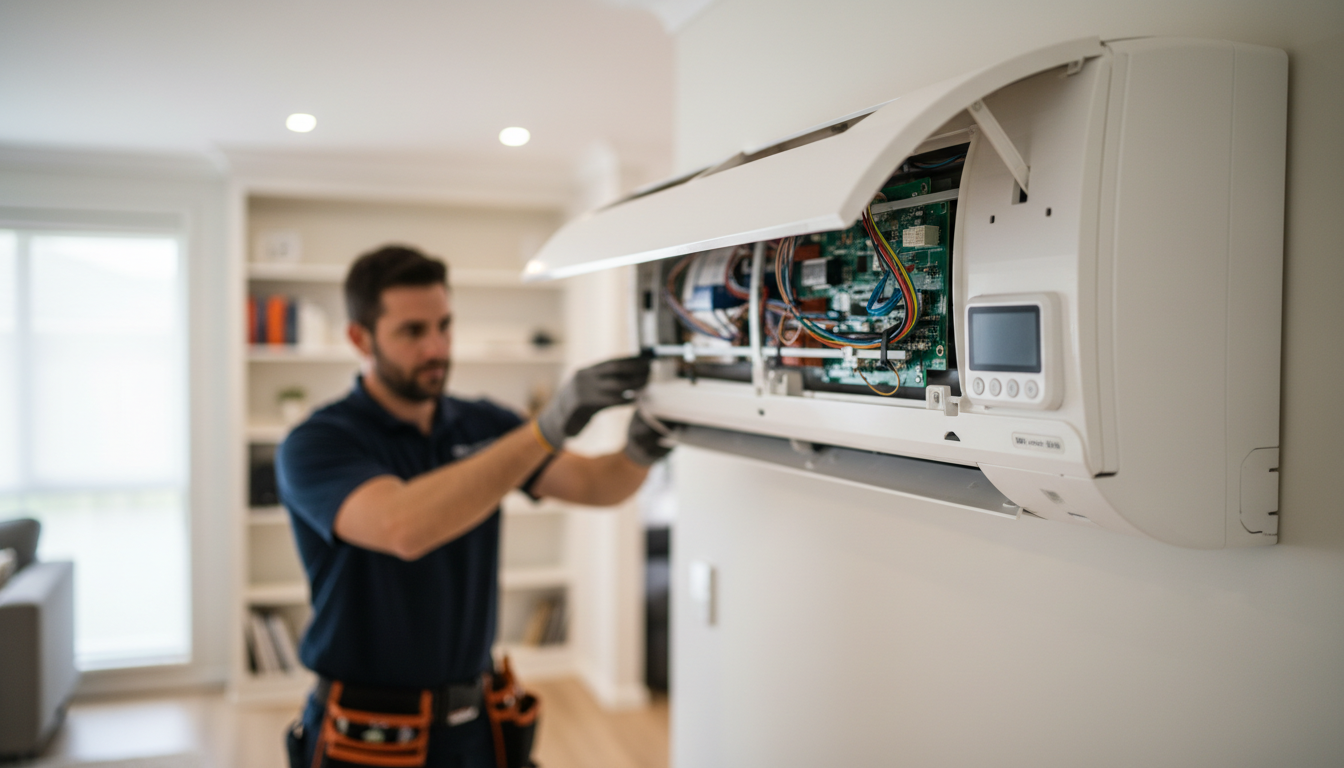
Electronic control boards manage all system functions including start-up sequencing, safety monitoring, and defrost cycles. These printed circuit boards contain microprocessors, relays, transformers, and solid-state components vulnerable to power surges, moisture ingress, and thermal stress. Sydney’s summer storms create voltage fluctuations and lightning-induced surges that damage sensitive electronics, particularly in older installations lacking surge protection devices.
Control board failures manifest in various ways: complete system non-response, error codes displayed on controllers, or partial operation where fans run but compressors don’t start. Modern systems display fault codes indicating specific failures—compressor lockout, sensor errors, communication faults, or safety shutoffs. Interpreting error codes on your controller provides valuable diagnostic information for technicians, so document any displayed codes before calling for service.
Relay failures on control boards prevent power reaching compressors or fan motors despite correct control signals. These electromechanical components click audibly when energizing—absence of clicking when the system should start indicates relay failure or control board problems. Replacement control boards cost $300-$800 depending on system complexity, making this a significant repair, but often proves more economical than complete system replacement for units under 10 years old.
Blocked Condensate Drains Triggering Safety Shutoffs
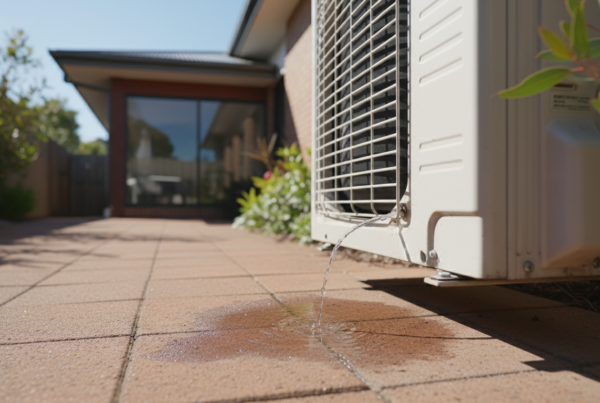
Air conditioning systems produce condensate water as humidity condenses on cold evaporator coils—typically 10-20 liters daily for residential systems in Sydney’s humid climate. This water drains through PVC pipes to external drainage points, but algae growth, dust accumulation, and insect nests frequently block these drains. When blockages occur, water backs up into the drain pan until a float switch activates, shutting down the system to prevent water damage.
Float switches represent a simple but critical safety device—a buoyant sensor that rises with water level and breaks the control circuit when water reaches unsafe levels. This protection prevents ceiling water damage and electrical hazards from water contacting live components. The system refuses to start until water levels drop and the float switch resets, which may require manual drain pan evacuation if blockages prevent normal drainage.
Condensate drain maintenance involves annual flushing with diluted vinegar or specialized algaecide products, but established blockages often require professional clearing with compressed air or specialized tools. Prevention includes ensuring drain lines slope continuously downward without low spots where water accumulates, and installing drain line access points for periodic cleaning.
When to Call a Licensed Technician vs DIY Fixes
Clear boundaries exist between homeowner-safe checks and work requiring professional qualifications. You can safely perform these diagnostic steps without risk:
- ✓
Check your switchboard for tripped circuit breakers or safety switches and reset if necessary - ✓
Verify thermostat batteries are fresh and controller displays are functioning normally - ✓
Inspect outdoor unit for debris, leaf buildup, or physical obstructions blocking airflow - ✓
Confirm temperature setpoint is at least 2-3°C below current room temperature in cooling mode - ✓
Check condensate drain line for blockages causing overflow switch activation - ✓
Listen for clicking sounds at the outdoor unit indicating compressor attempt without start-up - ✓
Verify all isolation switches near indoor and outdoor units are in the ON position - ✓
Document any error codes displayed on the controller before calling for service
Professional diagnosis becomes necessary when these checks reveal no obvious problems or when you observe signs requiring immediate professional attention including burning smells, sparking, repeated breaker tripping, or refrigerant hissing sounds. ARC Tick licensed technicians possess specialized diagnostic equipment including multimeters, refrigerant gauges, infrared thermometers, and capacitance testers that identify failures invisible to visual inspection.
Preventative Measures to Avoid Start-Up Failures
Regular maintenance dramatically reduces start-up failure frequency while improving efficiency and extending system lifespan. Energy Rating Australia data shows that poorly maintained air conditioning systems consume 15-30% more electricity and experience start-up failures at three times the rate of regularly serviced units. Implementing preventative maintenance schedules addresses problems before they cause complete failures.
Annual professional servicing should include electrical connection inspection and tightening, capacitor testing with capacitance meters, refrigerant pressure verification, condensate drain flushing, and control system diagnostics. Vital Air Conditioning recommends pre-season servicing in September or October before Sydney’s peak cooling demand stresses systems already weakened by winter dormancy. This timing identifies developing problems when technician availability is better and before emergency failures occur during 40-degree heatwaves.
Between professional services, homeowners should clean or replace air filters monthly during heavy use periods, keep outdoor units clear of vegetation maintaining 500mm clearance on all sides, and verify condensate drains flow freely. These simple measures prevent the majority of airflow-related failures and drainage issues that trigger safety shutoffs.
Surge protection devices installed at the switchboard provide valuable protection for control boards and electronic components, particularly important in Sydney’s storm-prone climate. These devices cost $200-$400 installed but prevent control board failures costing $500-$1,000 in repairs plus emergency service call fees.
Frequently Asked Questions About Air Conditioners Not Starting
Why won’t my air conditioner turn on after a power outage?
Power surges during outages can trip safety switches or damage capacitors and control boards. AS/NZS 3000:2018 (Electrical Installations) requires surge protection on fixed appliances, but older installations may lack this. Wait 5 minutes after power restoration, check your switchboard for tripped breakers, then attempt restart—if unsuccessful, an ARC Tick licensed technician should inspect for component damage.
Can I fix an air conditioner that won’t turn on myself?
You can safely check circuit breakers, replace thermostat batteries, clear debris from outdoor units, and ensure controller settings are correct. However, any work involving refrigerant systems, electrical wiring, or internal components requires an ARC Tick licensed technician under the Ozone Protection and Synthetic Greenhouse Gas Management Act 1989. Capacitor replacement, though common, involves high-voltage components and should be performed by qualified technicians.
How much does it cost to repair an air conditioner that won’t start in Sydney?
Diagnostic callouts typically range $120-$180 in Sydney, with repairs from $180 for simple fixes like capacitor replacement to $800+ for control board replacement. Compressor failures may cost $1,200-$2,500 depending on system capacity. ARC Tick licensed technicians must provide written quotes for refrigerant work exceeding $500 under Australian Consumer Law.
What is the lifespan of an air conditioner capacitor?
Start and run capacitors typically last 10-15 years under normal Sydney conditions, but can fail earlier in coastal areas due to salt air corrosion or in systems experiencing frequent power fluctuations. AS/NZS 60335.2.40:2015 (Safety of household appliances—Air conditioners) specifies capacitor safety standards, but doesn’t mandate replacement intervals—preventative replacement during routine servicing can prevent unexpected failures.
Why does my air conditioner not turn on but the fan works?
This indicates the indoor unit receives power but the compressor isn’t starting—common causes include failed start capacitors, compressor overload protection activation, refrigerant pressure faults, or control board failures. The compressor requires significantly more starting current than the fan motor, so capacitor or electrical supply issues often affect only compressor operation. This requires diagnosis by an ARC Tick licensed technician as it involves refrigerant system components.
When your air conditioner refuses to start, systematic diagnosis identifies the cause and determines appropriate action. Simple checks eliminate obvious problems, but most start-up failures involve components requiring professional expertise and specialized equipment. Understanding the distinction between homeowner-safe checks and work requiring licensed technicians protects both your safety and your investment while ensuring repairs meet Australian Standards and regulatory requirements. For comprehensive troubleshooting guidance, review other common AC problems affecting Sydney systems.
Vital Air Conditioning has diagnosed and repaired air conditioning start-up failures across Sydney for over 25 years. Our ARC Tick licensed technicians provide same-day service with a comprehensive 5-year warranty on all repairs. Contact us for expert diagnosis and reliable solutions.