You walk into your living room and notice water dripping from your split system air conditioner onto the floor. Your first instinct might be to grab a bucket and search for quick fixes online, but the reality is that an air conditioner leaking water signals one of two very different problems: a blocked condensate drain that can often be cleared with basic maintenance, or a refrigerant leak causing evaporator coil freezing that requires immediate attention from licensed professionals. Understanding which issue you’re facing determines whether you need a service call or emergency refrigerant handling under strict Australian regulations. Vital Air Conditioning’s ARC Tick licensed technicians have diagnosed and repaired both scenarios across Sydney for over 25 years, and this guide will walk you through the diagnostic process to identify which problem is affecting your system. For comprehensive background on the common causes of air conditioner water leaks, understanding the distinction between mechanical drainage failures and refrigerant system faults is essential for proper diagnosis.
Why Your Air Conditioner Leaking Water Needs Immediate Diagnosis
Water leaking from an air conditioning system is never normal operation, and delaying diagnosis creates cascading problems that extend far beyond the immediate puddle on your floor. When water escapes the designed drainage pathway, it contacts building materials, electrical components, and structural elements that were never intended to handle moisture exposure. AS/NZS 3000:2018 (Electrical installations — Wiring rules) specifically addresses the risks of water contact with electrical systems, requiring immediate isolation of power when moisture threatens electrical safety.
The urgency of diagnosis stems from the different damage patterns each cause creates. A blocked condensate drain produces steady, predictable water flow that damages ceilings, walls, and flooring through continuous saturation. According to the Australian Institute of Refrigeration, Air Conditioning and Heating (AIRAH), blocked condensate drains account for approximately 85% of internal water leak callouts in split system air conditioners across Australian residential installations. These mechanical blockages worsen over time as algae growth and biofilm accumulation increase, eventually causing complete drain line obstruction.
Refrigerant leaks present a different risk profile entirely. When refrigerant charge drops below design specifications, evaporator coil temperatures fall below freezing point, forming ice that melts during off-cycles or defrost modes. This intermittent flooding can overwhelm drain pans designed for normal condensate volumes, causing sudden water discharge that damages electronics and saturates insulation materials. The Australian Refrigeration Council reports that refrigerant leaks in domestic systems average 10-15% charge loss annually when left undetected, with R32 and R410A systems showing higher leak rates in coastal environments due to copper corrosion.
Beyond property damage, refrigerant loss causes compressor damage through inadequate lubrication and cooling. Compressors operating with insufficient refrigerant charge run hotter, work harder, and fail prematurely. The cost difference between early refrigerant leak detection and compressor replacement often exceeds $2,000 for residential split systems, making immediate diagnosis a financially prudent decision regardless of the underlying cause.
Understanding Normal Condensate vs Abnormal Water Leaks
Every air conditioning system operating in cooling mode produces condensate water as a normal byproduct of the refrigeration cycle. When warm, humid air passes over the cold evaporator coil, water vapour condenses on the coil surface exactly as water droplets form on a cold glass on a humid day. This condensate drips into a collection pan beneath the evaporator coil, then flows through a drain line to an external discharge point. Understanding how condensate drain systems work provides the foundation for distinguishing normal operation from system faults.
Normal condensate production in Sydney’s humid coastal climate ranges from 0.5 to 1.5 litres per hour per kilowatt of cooling capacity. A typical 7kW split system operating on a humid summer day produces between 3.5 and 10.5 litres of water during continuous operation. This water should exit through the designated drain line to an approved discharge point, never appearing inside the conditioned space or dripping from the indoor unit. The impact of how Sydney’s humidity impacts condensate production becomes particularly evident during February and March when relative humidity peaks above 70% and condensate volumes reach their annual maximum.
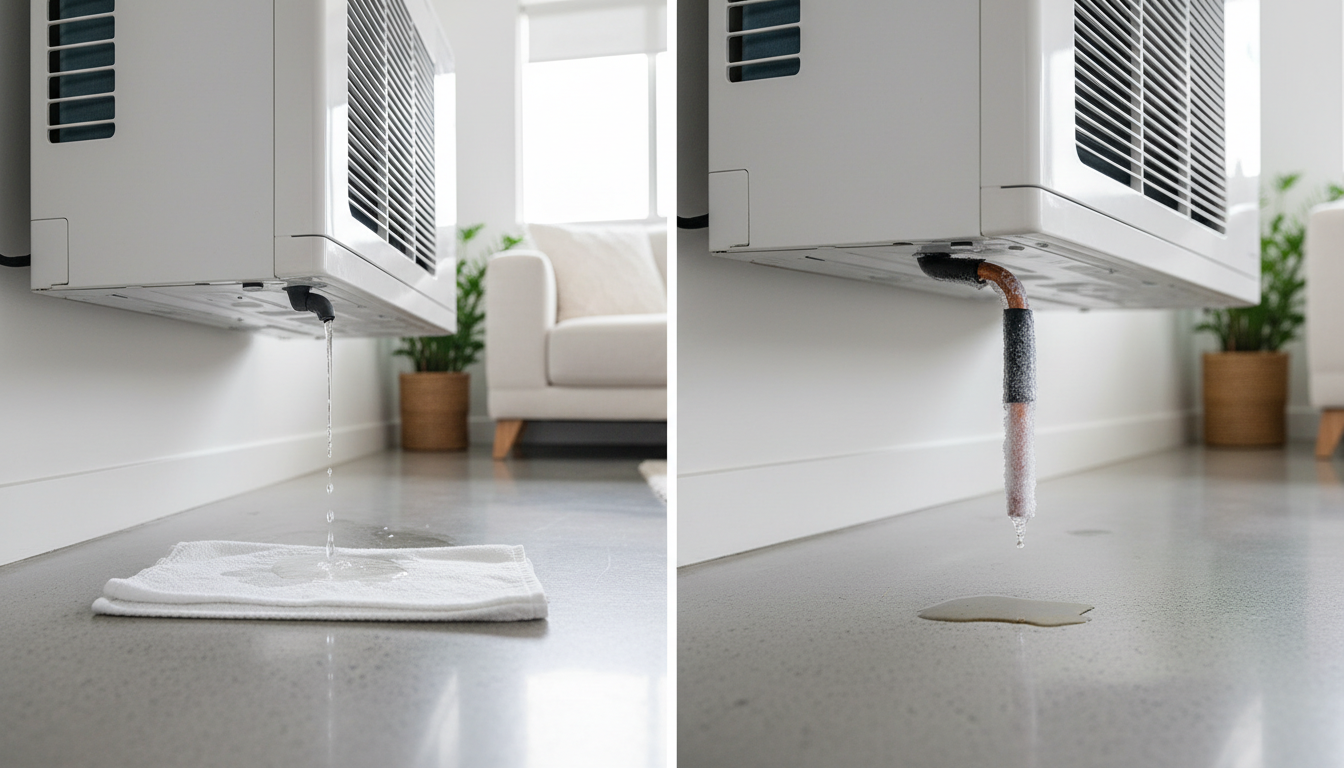
Abnormal water leaks manifest in several distinct patterns that indicate specific system faults. Steady dripping from the indoor unit during operation with normal cooling performance typically indicates drain line blockage or improper drain slope. Intermittent water discharge accompanied by ice formation on copper refrigerant lines signals refrigerant loss and evaporator coil freezing. Water pooling in the drain pan beneath the indoor unit suggests either drain blockage or excessive condensate production from coil freezing cycles. Each pattern requires different diagnostic approaches and repair methodologies.
The evaporator coil surface temperature during normal operation ranges from 2 to 8°C, cold enough to condense water vapour but warm enough to prevent ice formation. When refrigerant charge drops below design specifications, evaporator pressure decreases and coil temperature falls below 0°C. Ice forms on the coil surface and copper refrigerant lines, blocking airflow and reducing heat transfer efficiency. When the system cycles off or enters defrost mode, this ice melts rapidly and produces water volumes that exceed normal condensate rates by factors of three to five, overwhelming drain pans designed for steady-state condensate flow.
Blocked Condensate Drain: The Most Common Cause of Internal Leaks
Condensate drain blockages represent the overwhelming majority of internal water leak complaints in Sydney residential air conditioning systems. The drain line environment creates ideal conditions for algae growth, biofilm formation, and sediment accumulation. Condensate water contains dissolved minerals, airborne dust particles, and organic material that settle in drain lines and provide nutrients for microbial growth. Sydney’s warm, humid climate accelerates this biological activity, particularly during summer months when condensate production peaks and drain lines remain continuously wet.
The typical condensate drain system consists of a collection pan beneath the evaporator coil, a drain outlet connection, and a drain line that slopes continuously downward to an external discharge point. AS/NZS 3000:2018 requires minimum drain line slope of 1:100 (one centimetre fall per metre of horizontal run) to ensure gravity drainage without standing water. Installation errors that create sags, reverse grades, or inadequate slope allow water to pool in drain lines, creating stagnant conditions where algae and biofilm thrive. Over months of operation, these biological growths form thick mats that progressively restrict water flow until complete blockage occurs.
Drain blockages produce characteristic symptoms that distinguish them from refrigerant-related water leaks. Water drips from the indoor unit during operation, typically from the front edge of the unit where the drain pan overflows. Cooling performance remains normal, with supply air temperature 10 to 14°C below room temperature. No ice formation appears on copper refrigerant lines or the evaporator coil. The external drain outlet shows no water discharge during system operation, confirming that condensate cannot exit through the designed pathway. These symptoms indicate a mechanical drainage problem rather than a refrigerant system fault.
Dust accumulation from construction activity in growing Sydney suburbs like Moorebank contributes significantly to drain blockages. Airborne dust particles enter the indoor unit through the return air grille, some bypassing the air filter and settling on the evaporator coil. During condensate formation, these particles wash off the coil surface and enter the drain system, accumulating at low points and constrictions. Areas experiencing residential development or renovation work see higher rates of drain blockages due to elevated airborne dust concentrations.
Professional drain cleaning involves several techniques depending on blockage severity and drain line accessibility. Technicians use wet-dry vacuums applied to the external drain outlet to extract blockages through suction. Drain line flushing with approved cleaning solutions dissolves biofilm and algae growth. Compressed air or nitrogen purging dislodges stubborn blockages. For severe cases, drain line replacement may be necessary when biological growth has permanently degraded pipe materials or installation defects prevent proper drainage.
How to Identify a Refrigerant Leak vs a Drainage Problem
Distinguishing between refrigerant leaks and drainage problems requires systematic observation of specific diagnostic markers that indicate which system is failing. The most reliable diagnostic indicator is ice formation on refrigerant lines or the evaporator coil. Refrigerant leaks cause evaporator pressure to drop below normal operating range, reducing coil surface temperature below freezing point. Ice forms on the copper suction line (the larger, insulated pipe connecting the indoor and outdoor units) and on the evaporator coil fins visible behind the indoor unit’s front panel. This ice formation never occurs with simple drain blockages, making it the definitive marker for refrigerant system faults.
Cooling performance degradation provides the second critical diagnostic marker. Drain blockages do not affect refrigerant system operation, so cooling capacity remains normal even as water leaks from the indoor unit. Refrigerant leaks progressively reduce cooling capacity as charge level drops. Supply air temperature rises from the normal 10 to 14°C below room temperature to only 5 to 8°C below room temperature. The system runs longer to achieve setpoint temperature, and during extreme heat may fail to reach setpoint entirely. This performance degradation accompanies water leaks when refrigerant loss is the underlying cause.
The timing and pattern of water discharge differs significantly between the two causes. Blocked drains produce steady water dripping during system operation that stops when the system cycles off. Refrigerant leak-induced water discharge occurs intermittently when ice melts during off-cycles or defrost modes, often producing sudden water surges rather than steady dripping. Homeowners frequently report finding large water puddles after returning home to a system that has been off during the day, a pattern consistent with ice accumulation during previous operation followed by rapid melting.
By the Numbers
- STATAccording to the Australian Institute of Refrigeration, Air Conditioning and Heating (AIRAH), blocked condensate drains account for approximately 85% of internal water leak callouts in split system air conditioners across Australian residential installations
- STATThe Australian Refrigeration Council reports that refrigerant leaks in domestic systems average 10-15% charge loss annually when left undetected, with R32 and R410A systems showing higher leak rates in coastal environments due to copper corrosion
External drain outlet inspection provides immediate diagnostic information. Locate the condensate drain discharge point outside your property, typically a small PVC pipe near the outdoor unit or terminating at ground level. During normal system operation on a humid day, water should drip steadily from this outlet. If the indoor unit is leaking water but no discharge appears at the external outlet, drain blockage is confirmed. If water discharges normally from the external outlet but the indoor unit still leaks, the problem likely involves drain pan overflow from excessive ice melt rather than simple blockage.
Refrigerant Leaks and Evaporator Coil Freezing: The Connection
The relationship between refrigerant leaks and evaporator coil freezing stems from fundamental thermodynamic principles governing refrigeration system operation. Refrigerant absorbs heat from indoor air as it evaporates in the evaporator coil, changing from liquid to vapour at a specific temperature determined by system pressure. This pressure-temperature relationship is precisely calibrated during system design and charging to maintain evaporator coil surface temperature between 2 and 8°C, cold enough for efficient heat transfer and condensate formation but warm enough to prevent ice formation.
When refrigerant leaks from the sealed system, total refrigerant charge decreases and evaporator pressure drops below design specifications. Lower pressure means lower evaporating temperature, following the pressure-temperature relationship defined in refrigerant property tables. As evaporator pressure falls, coil surface temperature drops below 0°C and ice begins forming on coil fins and copper tubing. This ice formation blocks airflow through the coil, further reducing heat transfer and causing coil temperature to drop even lower in a self-reinforcing cycle.
The ice accumulation pattern provides diagnostic information about leak severity and duration. Minor refrigerant loss causes ice formation on the suction line near the evaporator coil outlet, appearing as frost or ice on the larger copper pipe where it exits the indoor unit. Moderate refrigerant loss extends ice formation across the entire evaporator coil surface, visible as white frost coating the aluminium fins behind the indoor unit’s front panel. Severe refrigerant loss causes ice to extend along the suction line all the way to the outdoor unit, creating a continuous ice coating on the insulated copper pipe.
Understanding that refrigerant leak repairs require ARC Tick licensed technicians is essential because refrigerant handling is strictly regulated under Australian law. AS/NZS 5149.1:2016 (Refrigerating systems and heat pumps — Safety and environmental requirements) establishes comprehensive requirements for refrigerant system design, installation, and servicing. The Ozone Protection and Synthetic Greenhouse Gas Management Act 1989 makes it illegal for anyone without ARC Tick certification to purchase, handle, or recover refrigerants. This legal framework exists because refrigerants are potent greenhouse gases with global warming potentials hundreds to thousands of times greater than carbon dioxide.
Refrigerant leak detection requires specialized equipment including electronic leak detectors, nitrogen pressure testing equipment, and ultraviolet dye systems. ARC Tick licensed technicians use these tools to locate leak sources, which commonly occur at brazed joints, flare connections, valve cores, and areas where copper tubing contacts sharp edges or vibrates against structural elements. Coastal environments like Sydney experience accelerated copper corrosion from salt-laden air, particularly affecting outdoor unit components and refrigerant lines exposed to weather.
DIY Diagnostic Steps Before Calling a Technician
Homeowners can perform several safe diagnostic steps to gather information before contacting a technician, helping to communicate symptoms accurately and enabling more efficient service response. These diagnostic steps involve visual inspection and basic measurements that do not require opening refrigerant systems, working with electrical components, or removing safety covers. The goal is to identify observable symptoms that distinguish between drain blockages and refrigerant system faults, not to attempt repairs that require professional tools and licensing.
- 1
Locate and Inspect External Drain OutletFind the condensate drain discharge point outside your property, typically a small PVC pipe near the outdoor unit or at ground level. With the system running in cooling mode on a humid day, observe whether water drips from this outlet. No discharge during operation confirms drain blockage. Normal discharge with indoor leaking suggests ice melt overflow rather than simple blockage.
- 2
Check for Visible Ice FormationExamine the copper refrigerant lines where they connect to the indoor unit. The larger, insulated pipe (suction line) should feel cool but not frozen during operation. Ice or frost coating on this pipe indicates refrigerant system problems. Look for ice visible through the indoor unit’s air intake grille, which may indicate frozen evaporator coil fins. Ice formation definitively indicates refrigerant issues rather than simple drain blockage.
- 3
Measure Supply Air Temperature DifferenceUsing a standard thermometer, measure room air temperature and supply air temperature from the indoor unit’s discharge grille after the system has run for 15 minutes. Normal operation produces supply air 10 to 14°C cooler than room temperature. Temperature difference less than 8°C indicates reduced cooling capacity consistent with refrigerant loss. This simple measurement provides objective performance data for technician diagnosis.
- 4
Inspect and Clean Air FilterRemove the indoor unit’s air filter following manufacturer instructions. Blocked filters reduce airflow across the evaporator coil, which can cause coil freezing even with proper refrigerant charge. Clean the filter with warm water and mild detergent, allow to dry completely, and reinstall. If ice formation and water leaks persist after filter cleaning, refrigerant or drain system problems require professional diagnosis.
- 5
Document Water Leak Pattern and TimingNote whether water leaks continuously during operation or appears intermittently after the system has been off. Record approximate water volume and whether leaking occurs from specific locations on the indoor unit. This pattern information helps technicians diagnose whether drain blockage or ice melt is causing the leak. Photograph any ice formation or water damage to provide visual documentation.
- 6
Assess Cooling Performance ChangesCompare current cooling performance to normal operation. Note whether the system takes longer to reach setpoint temperature, runs continuously without cycling off, or fails to achieve comfortable temperatures during moderate weather. Progressive performance degradation over days to weeks indicates refrigerant loss, while sudden water leaking with normal cooling suggests drain blockage.
- 7
Turn Off System and Isolate Power if Water Contacts Electrical ComponentsAS/NZS 3000:2018 requires immediate power isolation if water threatens electrical safety. If water leaks near power outlets, light fittings, or electrical equipment, turn off the air conditioner and isolate power at the circuit breaker. Do not operate the system until a licensed technician has inspected for electrical safety hazards and water damage to electrical components.
These diagnostic steps provide valuable information for technician dispatch and service planning. Vital Air Conditioning’s service team uses this information to arrive with appropriate tools and parts, whether drain cleaning equipment for blockages or refrigerant leak detection and recovery equipment for refrigerant system faults. Clear symptom description enables more accurate service quotes and reduces diagnostic time on site.
- ✓
Check drain outlet pipe outside — water should drip during cooling operation - ✓
Inspect indoor unit for visible ice formation on copper refrigerant lines or evaporator coil - ✓
Measure supply air temperature — should be 10-14°C cooler than room temperature when cooling - ✓
Look for water pooling in drain pan beneath indoor unit (requires cover removal) - ✓
Test cooling performance — refrigerant leaks cause gradual capacity loss over days/weeks - ✓
Check air filter condition — blocked filters reduce airflow and can cause coil freezing - ✓
Verify drain line slope — should fall continuously toward outlet with no sags or reverse grades
When Water Leaks Require ARC Tick Licensed Refrigerant Handling
The legal and technical boundaries between homeowner maintenance and licensed professional work are clearly defined in Australian refrigeration regulations. Any work involving refrigerant system components, refrigerant handling, or refrigerant recovery requires ARC Tick certification under the Ozone Protection and Synthetic Greenhouse Gas Management Act 1989. This includes refrigerant leak detection, system pressure testing, refrigerant recovery, vacuum evacuation, and refrigerant charging. These activities require specialized equipment, technical knowledge, and legal authorization that only licensed technicians possess.
AS/NZS 5149.1:2016 (Refrigerating systems and heat pumps — Safety and environmental requirements) establishes comprehensive requirements for refrigerant system work. The standard specifies that only competent persons with appropriate training and certification may work on refrigerant systems. Refrigerant handling requires understanding of pressure-temperature relationships, proper use of manifold gauges, refrigerant recovery procedures, vacuum pump operation, and system charging calculations. ARC Tick certification demonstrates competency in these technical areas and legal authorization to purchase and handle refrigerants.
Water leaks accompanied by ice formation, reduced cooling capacity, or abnormal refrigerant line temperatures require immediate professional diagnosis. These symptoms indicate refrigerant system faults that will worsen without proper repair. Continuing to operate a system with refrigerant leaks causes progressive compressor damage, increased energy consumption, and eventual complete system failure. The cost difference between early refrigerant leak repair and delayed intervention that requires compressor replacement typically exceeds $2,000 for residential systems.
Professional refrigerant leak diagnosis involves multiple specialized tools and techniques. Electronic leak detectors sense refrigerant molecules in air at concentrations as low as 3 grams per year leak rate. Nitrogen pressure testing pressurizes the refrigerant system with inert gas to locate leaks through pressure drop measurement. Ultraviolet dye injection circulates fluorescent dye through the refrigerant system, making leak sites visible under UV light. These diagnostic methods require equipment investment, technical training, and practical experience that justify professional service costs.
Recognizing signs your system needs immediate professional attention enables timely intervention before minor refrigerant leaks cause major component damage. Ice formation, reduced cooling capacity, unusual hissing sounds near refrigerant connections, and oil stains on refrigerant lines all indicate refrigerant system problems requiring licensed technician diagnosis. Vital Air Conditioning provides same-day emergency service across Sydney Metro, Hills District, Eastern Suburbs, and Inner West for refrigerant leak emergencies that threaten system reliability or property safety.
The refrigerant recovery and system repair process follows strict environmental and safety protocols. Technicians use refrigerant recovery machines to extract remaining refrigerant from the system before opening refrigerant lines for leak repair. This prevents refrigerant release to atmosphere, which is illegal under environmental protection legislation and harmful to climate stability. After leak repair, technicians evacuate the system using vacuum pumps to remove air and moisture, then charge the system with precisely measured refrigerant quantities according to manufacturer specifications.
Preventing Future Water Leaks: Maintenance for Sydney’s Climate
Preventive maintenance tailored to Sydney’s humid coastal climate significantly reduces water leak incidents and extends air conditioning system lifespan. The combination of high humidity during summer months, salt-laden coastal air, and airborne dust from urban development creates conditions that accelerate both drain blockages and refrigerant system corrosion. Regular professional servicing addresses these climate-specific challenges before they cause system failures or water damage.
Understanding the recommended servicing intervals for Sydney conditions provides the foundation for effective maintenance scheduling. Annual professional servicing before each cooling season prevents 90% of drain-related water leaks according to industry data. This servicing includes condensate drain cleaning, drain line inspection for proper slope and integrity, drain pan cleaning and inspection for cracks or corrosion, and verification of drain outlet discharge.
Condensate drain maintenance during professional servicing involves several specific procedures. Technicians flush drain lines with approved cleaning solutions that dissolve biofilm and algae growth without damaging PVC drain materials. Drain pans receive thorough cleaning to remove sediment and biological growth that can block drain outlets. Drain line slope verification ensures continuous fall toward the discharge point without sags or reverse grades where water can pool. For systems with recurring drain problems, technicians may install drain line access ports for easier future cleaning or recommend drain line replacement if installation defects prevent proper drainage.
Refrigerant system inspection during annual servicing detects early signs of refrigerant leaks before they cause coil freezing and water damage. Technicians inspect refrigerant line connections for oil stains that indicate refrigerant seepage. Refrigerant pressure and temperature measurements verify proper system charge and identify gradual refrigerant loss. Visual inspection of copper refrigerant lines identifies corrosion damage from coastal salt exposure, particularly on outdoor unit components and exposed line sets. Early detection enables leak repair before significant refrigerant loss occurs and compressor damage develops.
Air filter maintenance represents the most important homeowner contribution to preventing water leaks. Blocked air filters reduce airflow across the evaporator coil, causing coil temperature to drop below freezing even with proper refrigerant charge. Monthly filter inspection and cleaning during peak cooling season prevents airflow restriction. Washable filters require thorough drying before reinstallation to prevent moisture-related mould growth. Disposable filters should be replaced rather than cleaned when dust accumulation becomes visible.
Vital Air Conditioning has serviced Sydney air conditioning systems for over 25 years, developing maintenance protocols specifically designed for local climate conditions and common failure modes. Our preventive maintenance programs include comprehensive drain system cleaning, refrigerant system inspection, electrical safety testing, and performance verification. These services are backed by our 5-year workmanship warranty, providing long-term protection against service-related failures. Regular maintenance through our programs reduces emergency service calls by 75% according to customer service records, demonstrating the effectiveness of preventive care.
Seasonal preparation before summer cooling season provides additional protection against water leaks during peak demand periods. Pre-season servicing in October or November ensures drain systems are clear before humidity peaks in January and February. Refrigerant system inspection before cooling season identifies refrigerant leaks that developed during winter dormancy. This timing enables repair scheduling before emergency service demand increases during summer heatwaves, avoiding extended wait times and premium emergency service rates.
Frequently Asked Questions
Can a refrigerant leak cause my air conditioner to leak water inside?
Yes. Low refrigerant pressure causes evaporator coil temperatures to drop below 0°C, forming ice. When the system cycles off or switches to defrost mode, this ice melts rapidly and can overwhelm the drain pan. Under AS/NZS 5149.1:2016 (Refrigerating systems and heat pumps — Safety and environmental requirements), only ARC Tick licensed technicians may diagnose and repair refrigerant leaks. The ice formation and subsequent melting creates water volumes three to five times greater than normal condensate production, causing drain pan overflow and internal water leaks even when drain lines are functioning properly.
How do I know if my aircon leaking water is from a blocked drain or refrigerant issue?
Blocked drains typically cause steady water dripping during operation with normal cooling performance. Refrigerant leaks cause ice formation on copper lines or the indoor coil, reduced cooling capacity, and intermittent water leaks when ice melts. Check for visible ice, measure supply air temperature (should be 10-14°C below room temperature), and inspect the condensate drain outlet for blockages. If water drips steadily with no ice formation and normal cooling, drain blockage is likely. If ice appears on refrigerant lines with reduced cooling capacity, refrigerant loss requires licensed technician diagnosis.
What causes condensate drains to block in Sydney air conditioners?
Algae and biofilm growth thrive in Sydney’s humid coastal climate, particularly during summer when condensate production peaks. Dust accumulation from construction activity in growing suburbs like Moorebank, combined with inadequate drain slope (AS/NZS 3000:2018 requires minimum 1:100 fall), causes blockages. Regular servicing every 12 months prevents 90% of drain-related water leaks. The combination of warm temperatures, continuous moisture, and organic material in condensate water creates ideal conditions for biological growth that progressively restricts drain line flow until complete blockage occurs.
Is it safe to keep running my AC if it’s leaking water?
No. Continued operation risks water damage to ceilings, walls, and electrical components. If caused by refrigerant loss, running the system accelerates compressor damage due to inadequate lubrication and cooling. AS/NZS 3000:2018 (Electrical installations) requires immediate shutdown if water contacts electrical components. Isolate power and contact an ARC Tick licensed technician. Water leaking indicates a system fault that will worsen with continued operation, potentially causing thousands of dollars in additional damage to both the air conditioning system and building structure.
Vital Air Conditioning’s ARC Tick licensed technicians have diagnosed and repaired water leaks across Sydney for over 25 years. We provide same-day service with refrigerant leak detection equipment and drain cleaning tools, backed by our 5-year workmanship warranty on all repairs.