By the Numbers
- STATEnergy Rating Australia reports that maintaining clean air conditioner filters can improve system efficiency by up to 15%, directly reducing electricity consumption during Sydney’s peak summer demand periods
- STATThe Australian Institute of Refrigeration, Air Conditioning and Heating (AIRAH) identifies that 40% of residential HVAC service calls relate to airflow problems caused by neglected filter maintenance
- STATAccording to the Department of Climate Change and Energy Efficiency (DCCEE), air conditioning accounts for approximately 40% of household electricity use in NSW during summer, making filter maintenance a significant energy-saving opportunity
Energy Rating Australia reports that maintaining clean air conditioner filters can improve system efficiency by up to 15%, directly reducing electricity consumption during Sydney’s peak summer demand periods. This single aspect of air conditioner maintenance delivers measurable benefits to both your energy bills and the quality of air circulating through your home. As ARC Tick certified technicians who have serviced Sydney air conditioning systems for over 25 years, we consistently observe the cascading effects of neglected filter maintenance on system performance, indoor air quality, and component longevity.
The relationship between filter condition and system performance is not merely about dust accumulation. When filters become clogged, they create measurable changes in airflow dynamics, refrigerant heat exchange efficiency, and compressor operating parameters that directly impact your comfort and running costs. Understanding these technical relationships helps homeowners recognise why regular air conditioner maintenance represents an investment rather than an expense.
What Happens Inside Your Air Conditioner When Filters Become Clogged
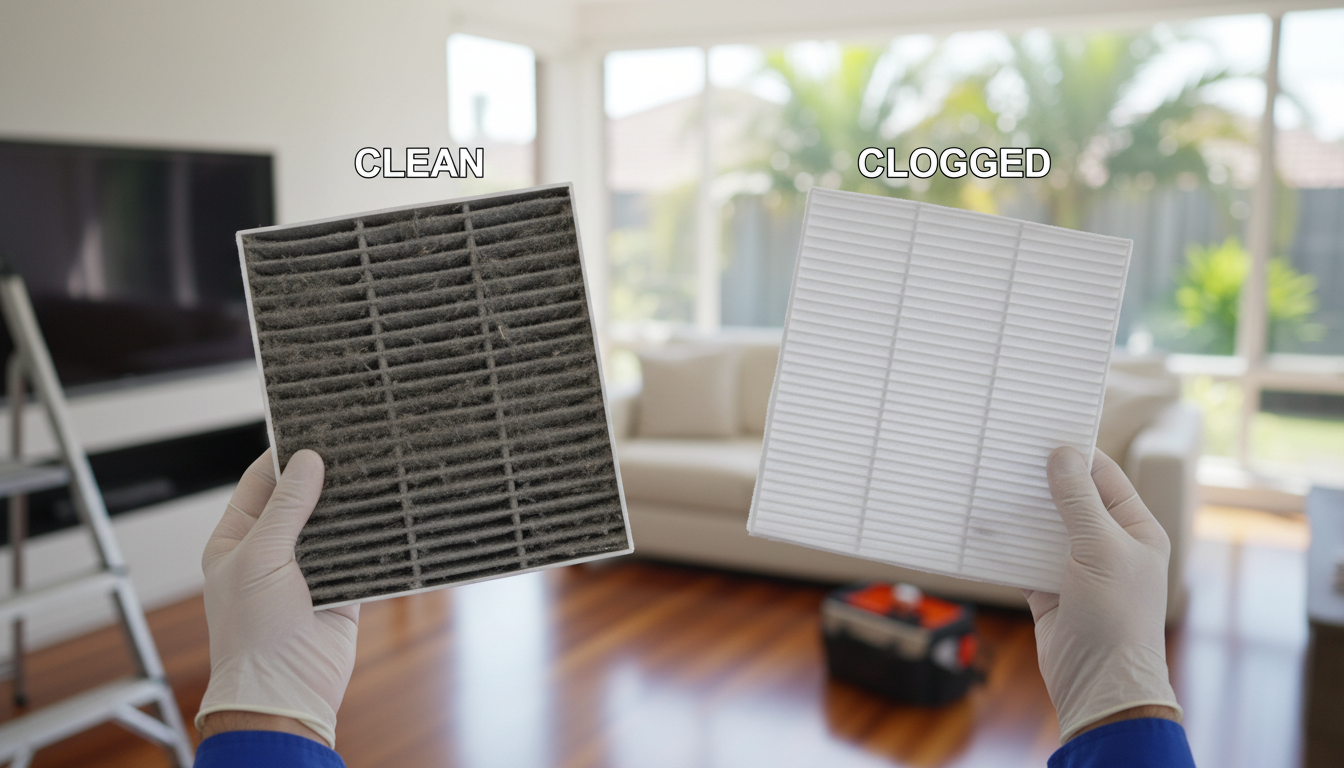
Air conditioner filters serve as the first line of defence against particulate matter entering the evaporator coil and indoor air distribution system. When these filters accumulate dust, pollen, textile fibres, and other airborne particles, they create a physical barrier that restricts airflow through the system. This restriction increases static pressure across the evaporator coil, fundamentally altering the thermodynamic processes that enable refrigerant to absorb heat from indoor air.
In a properly functioning split system, the evaporator fan draws approximately 350-400 cubic metres per hour of air across the indoor coil per kilowatt of cooling capacity. When filter blockage reduces this airflow by 20-30%, the evaporator coil operates at lower temperatures than design specifications require. This causes the temperature differential between refrigerant and air to decrease, reducing heat transfer efficiency and forcing the compressor to operate at higher discharge pressures to maintain the desired indoor temperature.
The compressor responds to reduced evaporator airflow by increasing amperage draw, sometimes by 10-15% above nameplate specifications. This elevated current consumption occurs because the compressor must work harder to compress refrigerant vapour that has absorbed less heat than optimal design conditions require. Over extended periods, this operating condition accelerates wear on compressor components and increases the likelihood of premature failure requiring professional aircon service intervention.
How Filter Blockage Reduces Airflow and Cooling Capacity
Static pressure measurement provides the most accurate assessment of filter condition impact on system performance. A clean filter typically presents 15-25 Pascals of resistance to airflow in residential split systems. As particulate matter accumulates, this resistance can increase to 80-120 Pascals, creating a measurable reduction in volumetric airflow through the evaporator coil. This pressure differential forces the indoor fan motor to work harder while delivering less air volume to conditioned spaces.
The Australian Institute of Refrigeration, Air Conditioning and Heating (AIRAH) identifies that 40% of residential HVAC service calls relate to airflow problems caused by neglected filter maintenance. When airflow drops below manufacturer specifications, the evaporator coil cannot absorb heat at design capacity. A system rated for 5.0 kW cooling capacity operating with 30% airflow restriction may deliver only 3.5-4.0 kW of actual cooling, leaving occupants uncomfortable and prompting them to lower thermostat settings that further increase energy consumption.
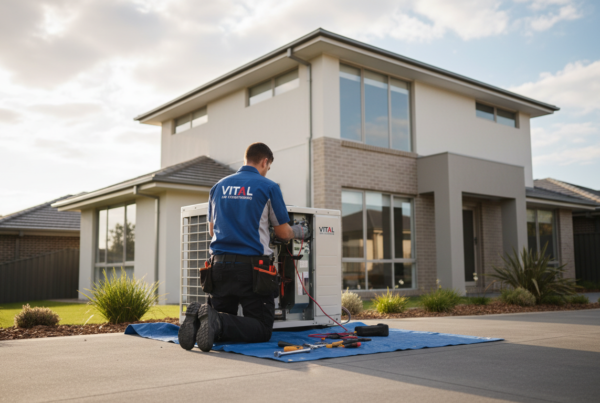
Beyond capacity reduction, restricted airflow creates uneven temperature distribution across the evaporator coil surface. Sections of the coil receiving minimal airflow can drop below dew point temperature, causing excessive condensation and potential ice formation. This ice buildup further restricts airflow, creating a compounding problem that often requires professional intervention to resolve. Our technicians at Vital Air Conditioning regularly encounter systems where ice accumulation has completely blocked airflow, necessitating system shutdown and controlled defrost procedures before normal operation can resume.
For comprehensive information on identifying and resolving these issues, refer to our guide on diagnosing airflow problems in air conditioners, which details the diagnostic procedures ARC Tick certified technicians use to assess system performance.
The Measurable Impact on Energy Efficiency and SEER Ratings
Seasonal Energy Efficiency Ratio (SEER) calculations assume that air conditioning systems operate under optimal conditions, including clean filters and unobstructed airflow. When filters become clogged, the actual operating efficiency deviates significantly from rated SEER values. A system rated at SEER 6.0 operating with heavily restricted filters may perform at an effective SEER of 5.0-5.5, representing a 10-15% increase in energy consumption for the same cooling output.
This efficiency degradation occurs through multiple mechanisms. The compressor’s elevated amperage draw directly increases electrical consumption. Simultaneously, the reduced cooling capacity prompts longer operating cycles to achieve thermostat setpoints, further increasing runtime hours. The combined effect can add 20-30% to cooling season electricity costs compared to the same system operating with clean filters and proper airflow.
According to the Department of Climate Change and Energy Efficiency (DCCEE), air conditioning accounts for approximately 40% of household electricity use in NSW during summer. Within this substantial energy allocation, filter maintenance represents one of the most cost-effective efficiency improvements available to homeowners. A filter cleaning that takes five minutes can prevent efficiency losses that cost hundreds of dollars over a single cooling season.
The relationship between filter condition and energy consumption becomes particularly significant in Sydney’s climate, where extended summer periods require consistent air conditioning operation. Systems operating 8-10 hours daily throughout December, January, and February accumulate substantial energy costs when filters restrict airflow. Regular maintenance prevents this efficiency degradation and maintains the system performance that manufacturers design into their equipment.
How Clogged Filters Degrade Indoor Air Quality
While energy efficiency concerns often motivate filter maintenance, indoor air quality impacts present equally significant health considerations. Air conditioner filters capture particulate matter ranging from large dust particles down to fine allergens and biological contaminants. When filters become saturated, they lose capture efficiency and may release accumulated particles back into the air stream during system operation.
AS/NZS 3666.1:2011 (Air-handling and water systems of buildings — Microbial control — Design, installation and commissioning) establishes requirements for maintaining indoor air quality in mechanically ventilated buildings. While this standard primarily addresses commercial installations, its principles apply equally to residential systems. The standard recognises that contaminated filters serve as reservoirs for microbial growth, particularly in humid environments where condensation provides moisture for mould and bacteria proliferation.
Sydney’s coastal environment presents particular challenges for air quality maintenance. Salt aerosols from ocean air combine with urban dust, pollen from native vegetation, and combustion particles from traffic to create a complex particulate load that accumulates rapidly on air conditioner filters. Systems operating in suburbs close to beaches or major roadways may require more frequent filter maintenance than those in less exposed locations.
The role of air filters in maintaining indoor air quality extends beyond simple particle capture. Clean filters enable proper airflow patterns that prevent stagnant air zones where contaminants concentrate. They also protect the evaporator coil from dust accumulation that creates surfaces for microbial colonisation. When filters fail to perform these functions due to saturation, indoor air quality degrades measurably, potentially triggering respiratory symptoms in sensitive occupants.
For detailed information on health implications, our article on the connection between indoor air quality and health explores how air conditioning maintenance directly impacts occupant wellbeing.
The Energy Cost of Running a System with Clogged Filters
Quantifying the financial impact of clogged filters requires understanding both the efficiency penalty and typical operating patterns. A 5.0 kW split system operating 8 hours daily throughout a 90-day summer period consumes approximately 2,160 kWh at rated efficiency. If filter blockage reduces efficiency by 15%, this same cooling output requires an additional 324 kWh. At Sydney’s average electricity rate of 30 cents per kWh, this represents approximately 97 dollars in unnecessary energy costs for a single cooling season.
This calculation assumes moderate filter contamination. Severely clogged filters that reduce airflow by 40-50% can double the efficiency penalty, potentially adding 200-250 dollars to seasonal cooling costs for a typical residential system. These figures exclude the accelerated component wear that increases the likelihood of compressor failure or refrigerant leaks requiring expensive repairs.
The compounding nature of filter neglect makes early intervention particularly cost-effective. A filter cleaned at the first signs of restriction prevents the cascading effects of reduced airflow on system components. Conversely, filters left unchanged for entire cooling seasons subject compressors to elevated discharge pressures and increased operating temperatures that accelerate wear on internal components.
Vital Air Conditioning has documented numerous cases where homeowners experiencing high electricity bills discovered that simple filter maintenance resolved the issue without requiring component replacement or refrigerant service. This diagnostic finding underscores the importance of eliminating basic maintenance deficiencies before investigating more complex system faults. For additional strategies to manage cooling costs, review our energy-saving tips for your air conditioner.
How Often Should Filters Be Cleaned or Replaced
Filter maintenance frequency depends on system type, operating hours, and environmental conditions. AIRAH recommends cleaning washable filters every 2-4 weeks during peak usage periods in Sydney’s summer months. This frequency assumes typical suburban environments with moderate dust exposure. Systems operating in high-dust environments, homes with pets, or properties near construction sites may require weekly cleaning to maintain adequate airflow.
Split system air conditioners typically use washable mesh filters that capture larger particles but allow smaller allergens to pass through. These filters require removal, washing with lukewarm water and mild detergent, complete drying, and reinstallation. The entire process takes 10-15 minutes and prevents the airflow restrictions that degrade system performance. Filters must be completely dry before reinstallation to prevent moisture introduction into the air handling system.
Ducted systems often incorporate pleated filters with higher MERV (Minimum Efficiency Reporting Value) ratings that capture smaller particles than standard mesh filters. MERV 8 filters capture particles down to 3.0 microns, including mould spores and some pollen. MERV 11 filters capture particles to 1.0 microns, providing enhanced protection against fine dust and allergens common in Sydney’s urban environment. These pleated filters cannot be washed and require replacement every 3 months during regular use, or more frequently if visual inspection reveals significant discolouration.
Manufacturer warranty conditions often specify minimum filter maintenance frequencies. Failure to maintain filters according to these schedules may void warranty coverage for compressor failures or refrigerant system faults that result from restricted airflow. Documenting filter maintenance dates provides evidence of compliance should warranty claims become necessary.
Our comprehensive guide to air conditioning filter maintenance provides detailed schedules and procedures for various filter types and system configurations common in Sydney installations.
Filter Types and Their Maintenance Requirements
Understanding filter construction and efficiency ratings helps homeowners select appropriate maintenance intervals and replacement products. Standard mesh filters in split systems use synthetic fibres woven into a coarse matrix that captures particles larger than 10 microns. These filters provide basic protection for evaporator coils while maintaining low airflow resistance. Their washable construction makes them economical for long-term use, though their limited particle capture efficiency means they provide minimal air quality benefits beyond coil protection.
Pleated filters incorporate accordion-folded media that increases surface area within compact dimensions. This design captures smaller particles while maintaining acceptable airflow resistance. MERV ratings quantify capture efficiency: MERV 6 filters capture 35-50% of particles in the 3.0-10.0 micron range, while MERV 11 filters capture 65-80% of particles in the 1.0-3.0 micron range. Higher MERV ratings provide better air quality but increase static pressure, requiring verification that the air handling system can accommodate the additional resistance without reducing airflow below design specifications.
Electrostatic filters use charged fibres to attract and capture particles through electrical forces rather than mechanical filtration alone. These filters can achieve MERV 8-10 performance while maintaining lower pressure drop than equivalent pleated filters. Some electrostatic filters are washable, though the washing process may degrade the electrostatic charge over time, reducing capture efficiency in older filters.
HEPA (High Efficiency Particulate Air) filters represent the highest efficiency category, capturing 99.97% of particles 0.3 microns and larger. These filters find application in medical facilities and cleanroom environments but rarely suit residential air conditioning systems due to their high static pressure requirements. Residential systems lack the fan capacity to overcome HEPA filter resistance while maintaining design airflow rates. Homeowners seeking HEPA filtration typically require dedicated air purification systems separate from the air conditioning equipment.
AS/NZS 3666.1:2011 provides guidance on filter selection for various applications, emphasising the need to balance particle capture efficiency against system airflow requirements. ARC Tick certified technicians assess these factors during professional aircon service visits, recommending filter upgrades where appropriate and verifying that installed filters match system capabilities.
When to Call a Professional for Aircon Service
While filter cleaning represents straightforward maintenance that homeowners can perform, several conditions indicate the need for professional assessment. Ice formation on the evaporator coil suggests that airflow restriction has progressed beyond simple filter contamination. Ice buildup may indicate refrigerant charge problems, failed fan motors, or blocked condensate drainage in addition to filter issues. These conditions require diagnostic equipment and refrigerant handling capabilities that only ARC Tick licensed technicians possess.
Persistent odours emanating from the air conditioning system during operation indicate microbial contamination that has colonised the evaporator coil or drainage system. While filter cleaning may reduce odour intensity, complete remediation requires coil cleaning with appropriate antimicrobial treatments and drainage system flushing. These procedures form part of comprehensive aircon service that addresses contamination throughout the air handling system.
Reduced cooling capacity that persists after filter cleaning suggests underlying system faults requiring professional diagnosis. Refrigerant leaks, compressor wear, or expansion valve problems produce symptoms similar to filter restriction but cannot be resolved through maintenance alone. Attempting to compensate for these faults by lowering thermostat settings increases energy consumption without addressing the root cause.
The Ozone Protection and Synthetic Greenhouse Gas Management Act 1989 requires that all persons handling refrigerants hold appropriate ARC Tick certification. This licensing requirement ensures that technicians possess the knowledge to handle refrigerants safely, prevent environmental releases, and comply with recovery and recycling obligations. Homeowners should never attempt refrigerant system repairs, as doing so violates federal law and creates safety hazards from high-pressure refrigerant releases.
Our guide to signs your air conditioner needs professional servicing details the specific symptoms that indicate system faults beyond routine maintenance scope.
Professional Aircon Service vs DIY Filter Maintenance
Distinguishing between homeowner-appropriate maintenance and tasks requiring professional service protects both system integrity and personal safety. Filter cleaning, thermostat operation, and external unit debris removal represent maintenance activities that homeowners can safely perform. These tasks require no specialised tools, involve no electrical or refrigerant system contact, and present minimal risk when performed according to manufacturer instructions.
Professional aircon service encompasses diagnostic testing, refrigerant system assessment, electrical component inspection, and performance verification that require specialised equipment and technical knowledge. ARC Tick certified technicians use manifold gauges to measure refrigerant pressures, multimeters to verify electrical parameters, and airflow measurement devices to confirm system performance against manufacturer specifications. These diagnostic procedures identify developing problems before they cause system failures.
Comprehensive service visits include evaporator and condenser coil cleaning, condensate drainage inspection, electrical connection tightening, and refrigerant charge verification. Coil cleaning requires chemical treatments and high-pressure water equipment that homeowners typically lack. Refrigerant work requires recovery equipment, vacuum pumps, and charging scales that represent significant capital investment beyond the needs of residential property owners.
Annual professional service provides documentation of system condition that supports warranty claims and identifies maintenance needs before they escalate into expensive repairs. Vital Air Conditioning’s service reports detail refrigerant pressures, electrical measurements, and component conditions, creating a maintenance history that tracks system performance over time. This documentation proves particularly valuable when diagnosing intermittent faults or assessing whether system replacement represents better value than continued repairs on aging equipment.
For guidance on appropriate service intervals, consult our article on how often you should have your air conditioner serviced, which outlines recommended schedules based on system type and usage patterns.
- ✓
Check filter condition every 2 weeks during summer operation and monthly during cooler months - ✓
Clean washable filters with lukewarm water and allow to dry completely before reinstalling - ✓
Replace disposable pleated filters when visibly discoloured or every 3 months minimum - ✓
Inspect evaporator coil fins for dust accumulation behind the filter during cleaning - ✓
Document filter maintenance dates to maintain manufacturer warranty compliance - ✓
Schedule annual professional aircon service with ARC Tick licensed technician to assess system airflow and refrigerant charge
Frequently Asked Questions
How much does a clogged filter reduce air conditioner efficiency?
A clogged filter can reduce HVAC system efficiency by 5-15% according to Energy Rating Australia. The restriction increases static pressure across the evaporator coil, forcing the compressor to work harder and consume more energy while delivering less cooling capacity measured in kW output. This efficiency penalty translates directly to increased electricity costs throughout the cooling season, with severely restricted filters potentially adding 20-30% to operating expenses compared to systems with clean filters.
Can a dirty air conditioner filter make you sick?
Yes. Clogged filters accumulate dust mites, mould spores, pollen, and bacteria that recirculate through indoor air. The Australian Institute of Refrigeration, Air Conditioning and Heating (AIRAH) identifies poor filter maintenance as a primary contributor to sick building syndrome and respiratory irritation in residential settings. Saturated filters lose capture efficiency and may release accumulated biological contaminants back into the air stream during system operation, particularly in humid conditions where moisture promotes microbial growth on filter media.
How often should I clean my split system air conditioner filter?
AIRAH recommends cleaning washable filters every 2-4 weeks during peak usage periods in Sydney’s summer months. Systems operating in high-dust environments or homes with pets may require weekly cleaning to maintain airflow and comply with manufacturer warranty conditions under AS/NZS 3823 series standards. Monthly inspection during cooler months when usage decreases provides adequate monitoring, with cleaning performed when visual inspection reveals dust accumulation or when airflow from supply vents noticeably decreases.
What is the difference between cleaning and replacing an air con filter?
Washable mesh filters in split systems can be cleaned with water and mild detergent, while pleated HEPA or electrostatic filters in ducted systems must be replaced according to AS/NZS 3666.1 (Air-handling and water systems of buildings — Microbial control). ARC Tick licensed technicians assess filter condition during routine aircon service to determine replacement necessity. Washable filters require complete drying before reinstallation to prevent moisture introduction into the air handling system, while disposable filters should be replaced when visibly discoloured or every three months, whichever occurs first.
Vital Air Conditioning has maintained optimal cooling efficiency and indoor air quality for Sydney homes for over 25 years. Our ARC Tick certified technicians provide comprehensive aircon service including filter assessment, coil cleaning, and refrigerant testing backed by our 5-year warranty on workmanship.