When your air conditioner stops working during a Sydney summer, the discomfort is immediate and the instinct to fix it yourself is strong. Before you reach for tools or start searching online for complex repairs, there are several safe, non-technical checks you can perform that often resolve common issues when your ac not working situation arises. As qualified HVAC technicians with over 25 years servicing Sydney homes, we’ve seen countless service calls that could have been avoided with a few simple checks—and just as many situations where homeowner intervention created dangerous conditions or voided warranties.
According to the Australian Bureau of Statistics (ABS), 75% of Australian households have at least one air conditioner, with split systems accounting for 62% of installations—making basic troubleshooting knowledge essential for most Sydney homeowners. This guide walks you through seven safe diagnostic steps you can perform without tools, electrical work, or accessing refrigerant systems, while clearly identifying the legal and safety boundaries that require a licensed professional.
Safety First: What You Should Never Touch on Your AC Unit
Before we discuss what you can safely check, it’s critical to understand what Australian law prohibits homeowners from accessing. Under AS/NZS 5149.1:2016 (Refrigerating systems and heat pumps—Safety and environmental requirements), only technicians holding current ARC Tick certification can legally open refrigerant circuits, handle refrigerant gases, or perform work on sealed refrigeration systems. This isn’t merely a recommendation—it’s a legal requirement under the Ozone Protection and Synthetic Greenhouse Gas Management Act 1989.
Similarly, electrical work beyond resetting a tripped circuit breaker requires a licensed electrician under AS/NZS 3000:2018 (Electrical installations—Wiring Rules). You should never open electrical enclosures, test voltage, or bypass safety switches. The checks outlined below keep you safely outside these regulated areas while still addressing the most common causes of air conditioner not turning on complaints.
Check Your Thermostat and Controller Settings
Incorrect thermostat settings account for a significant portion of service calls where nothing is actually wrong with the equipment. When your air conditioner won’t start, begin with these controller checks:
First, verify the system is set to COOL mode, not FAN ONLY, DRY, or HEAT. Many controllers have similar icons that are easily confused. Second, check that your target temperature is set at least 2-3°C below the current room temperature. If your room is 26°C and the thermostat is set to 25°C, the compressor may not engage because the differential is insufficient to trigger cooling.
Third, examine any timer or scheduling functions. Many modern controllers allow programmed operation times that may have been accidentally activated. If your unit only runs during specific hours, this isn’t a fault—it’s following programmed instructions. Check the controller manual for how to disable timer functions if they’re interfering with operation.
Fourth, if your system has been off for an extended period, some models require a brief initialization period after power restoration. Wait 3-5 minutes after turning the system on before concluding it’s not responding. For more detailed diagnostic information when these basic checks don’t resolve the issue, our guide to 7 common causes why your air conditioner won’t turn on provides deeper technical context.
Inspect and Clean Your Air Filters
Dirty or blocked air filters are the single most common cause of reduced cooling performance and system shutdowns. When airflow is restricted, the evaporator coil temperature drops excessively, triggering safety cutouts that prevent the compressor from running. The Australian Institute of Refrigeration, Air Conditioning and Heating (AIRAH) recommends cleaning or replacing filters every 4-6 weeks during peak usage periods, though Sydney’s coastal humidity and summer dust loads often require monthly attention.
To access your filters safely, first turn off the air conditioner at the controller. Most split system indoor units have a front panel that lifts or slides open without tools—consult your owner’s manual for the specific mechanism. The filters are typically located immediately behind this panel, either as flat mesh screens or pleated cartridges.
Remove the filters carefully and inspect them in good light. If you can’t see through the material when held up to a window, they require cleaning. For washable mesh filters, rinse them under lukewarm tap water from the clean side, allowing water to push dirt out the way it entered. Never use hot water, harsh detergents, or scrubbing brushes, as these can damage the filter material. Allow filters to dry completely in shade before reinstalling—damp filters promote mould growth and reduce airflow.
Disposable pleated filters should be replaced rather than washed. Note the arrow indicating airflow direction printed on the filter frame and ensure the replacement is installed the same way. For comprehensive instructions on filter types, cleaning techniques, and replacement schedules specific to Sydney conditions, refer to our comprehensive guide to air conditioning filter maintenance.
Check Your Circuit Breaker and Isolator Switch
Electrical supply issues are another frequent cause of air conditioners that won’t start. Air conditioning systems draw significant current, particularly during compressor startup, and circuit protection devices may trip due to power surges, electrical faults, or simply age-related sensitivity.
Locate your home’s main switchboard and identify the circuit breaker dedicated to your air conditioner. These are typically labeled and may be rated between 16A and 32A depending on your system capacity. If the breaker switch is in the OFF or middle position, it has tripped. Reset it by switching fully OFF, then back to ON. If the breaker trips immediately when you attempt to run the air conditioner, this indicates an electrical fault that requires a licensed technician—do not repeatedly reset a tripping breaker.
Next, check the isolator switch located near your outdoor unit. This is a weatherproof switch box mounted on the external wall, usually within two metres of the condenser. Confirm it’s in the ON position. These switches are sometimes accidentally turned off during garden maintenance or by children.
If your circuit breaker trips repeatedly when the air conditioner starts, this may indicate a failing capacitor, compressor issue, or wiring fault. Our detailed article on why your air conditioner keeps tripping the circuit breaker explains the technical causes and why professional diagnosis is essential for persistent electrical faults.
Clear Obstructions Around Indoor and Outdoor Units
Air conditioners require unobstructed airflow to operate efficiently and safely. Both indoor and outdoor units need adequate clearance to draw in air, pass it over heat exchange coils, and exhaust it properly. Restricted airflow causes the system to work harder, run hotter, and eventually trigger thermal protection cutouts.
For your indoor unit, ensure furniture, curtains, or storage items are not blocking the air intake grilles or discharge vents. Maintain at least 30cm clearance on all sides where air enters or exits. Check that the discharge louvres can swing freely and aren’t obstructed by ceiling fans, light fittings, or decorative elements.
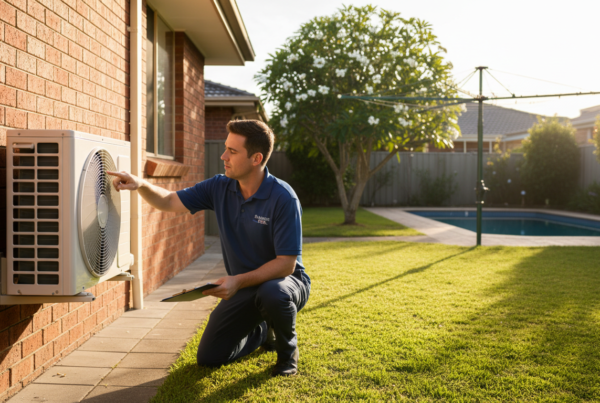
The outdoor unit requires even more attention. Inspect the condenser for leaves, grass clippings, spider webs, or debris accumulated in the protective grille. You can safely remove visible debris from the outside of the unit using a soft brush or vacuum cleaner, but never remove panels to access internal components. Ensure garden plants haven’t grown to within 30cm of the unit, and trim back any vegetation that restricts airflow.
Check that the outdoor unit isn’t enclosed by fencing, storage boxes, or building modifications that trap hot exhaust air. The Department of Climate Change and Energy Efficiency (DCCEE) reports that air conditioning accounts for approximately 40% of household electricity use during Sydney summer months, and restricted airflow can increase this consumption by 15-25% while reducing cooling capacity.
Look for Obvious Water Leaks or Ice Buildup
Water-related issues provide visible clues to system problems. During normal operation, your outdoor unit will produce condensate water that drains away naturally. However, water pooling around the indoor unit or ice formation on refrigerant lines indicates faults requiring professional attention.
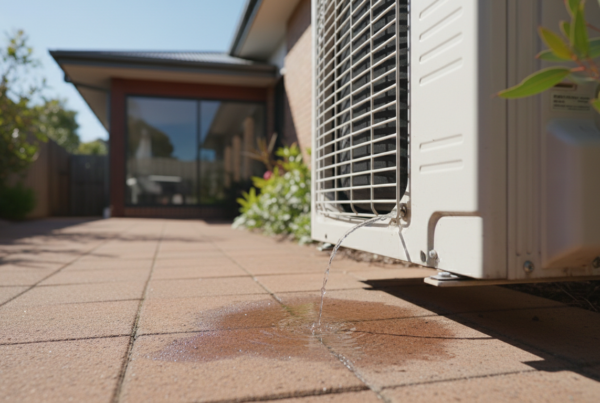
Indoor water leaks typically result from blocked condensate drain lines. The indoor evaporator coil produces condensate water that must drain away through a small pipe, usually terminating outside near the outdoor unit. If this drain becomes blocked by algae, dust, or debris, water backs up and overflows from the indoor unit. While you can visually inspect the external drain outlet for blockages, clearing internal drain lines requires specialized equipment and should be performed by a technician.
Ice formation on the refrigerant lines connecting your indoor and outdoor units indicates either severely restricted airflow (often from dirty filters) or low refrigerant charge. If you see ice, turn the system off immediately. Operating an icing system can cause compressor damage and significantly increase repair costs. For detailed information on drainage issues and their causes, see our guide to common causes of air conditioner water leaks.
Check Your Remote Control Batteries and Signal
A surprisingly common cause of air conditioners that won’t respond is simply flat or incorrectly installed remote control batteries. Before assuming a system fault, replace the batteries with fresh ones, ensuring correct polarity. Many remotes display a low battery indicator, but this warning often appears too late to maintain reliable operation.
After installing fresh batteries, test the remote by pointing it directly at the indoor unit from within 2-3 metres. Most units have a receiver window that emits a beep or light flash when receiving a signal. If the unit responds at close range but not from across the room, the remote’s infrared transmitter may be weak or the receiver window may be obstructed.
Check that the receiver window on the indoor unit isn’t blocked by furniture, decorations, or accumulated dust. Clean it gently with a soft, dry cloth. Ensure you’re within the remote’s specified range—typically 8 metres maximum—and that you have clear line of sight to the indoor unit. Infrared signals cannot pass through walls or around corners.
If the system still won’t respond to the remote after these checks, try the manual operation button located on the indoor unit itself. This button, usually behind the front panel or on the side of the unit, allows basic operation without the remote. If manual operation works but remote operation doesn’t, the issue is isolated to the remote or receiver, not the air conditioning system itself.
When to Stop and Call a Licensed Technician
If you’ve worked through the safe checks above and your air conditioner still isn’t working, it’s time to contact an ARC Tick certified technician. Certain symptoms indicate faults that are beyond homeowner diagnosis and require professional equipment, refrigerant handling authority, and electrical qualifications.
Call a licensed technician immediately if you observe any of the following:
- Circuit breakers that trip repeatedly when the air conditioner starts
- Burning smells, smoke, or sparking from any component
- Ice formation on refrigerant lines or the outdoor unit
- Loud grinding, squealing, or banging noises from the compressor
- Complete loss of cooling despite the system running
- Error codes displayed on the controller that persist after power cycling
- Refrigerant odors (sweet or chemical smell) near the units
- Water leaking from the indoor unit
- ✓
Confirm the circuit breaker hasn’t tripped and the isolator switch near the outdoor unit is in the ON position - ✓
Check thermostat is set to COOL mode and temperature is at least 2-3°C below current room temperature - ✓
Remove and clean air filters according to manufacturer instructions—dirty filters are the most common cause of reduced performance - ✓
Ensure both indoor and outdoor units have at least 30cm clearance from furniture, curtains, plants, and debris - ✓
Verify remote control has fresh batteries and is within 8 metres of the indoor unit with clear line of sight - ✓
Look for visible water pooling, ice formation on pipes, or unusual sounds—these require immediate professional attention - ✓
Document any error codes displayed on the controller—these provide diagnostic information for technicians
These symptoms indicate electrical faults, refrigerant leaks, compressor failure, or control system problems that require diagnostic equipment and repair techniques restricted to licensed professionals. Attempting DIY repairs on these issues violates Australian Standards, voids your warranty, and creates serious safety risks. For guidance on identifying symptoms that require immediate professional intervention, review our article on signs your air conditioner needs professional servicing.
During Sydney’s peak summer months, some failures constitute genuine emergencies requiring same-day response. Our guide to when your AC problem requires emergency repair helps you determine whether your situation warrants after-hours service or can wait for standard business hours.
What Vital Air Conditioning Checks During a Professional Service
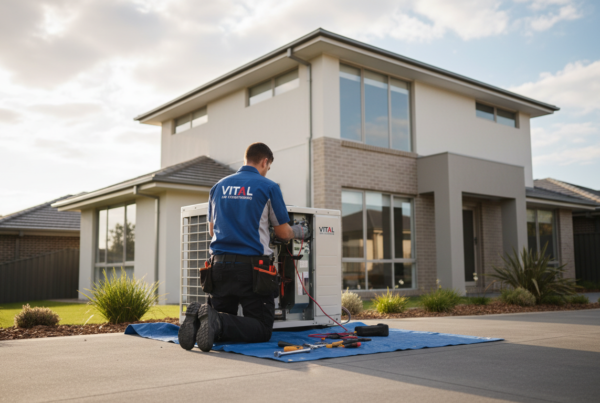
When you contact Vital Air Conditioning for a service call, our ARC Tick certified technicians perform comprehensive diagnostics that go far beyond the safe homeowner checks outlined above. Understanding what professional service involves helps you appreciate why certain work requires licensed expertise.
Our technicians begin with electrical testing using calibrated multimeters to measure voltage, current draw, and capacitor performance. We check that your system is receiving correct supply voltage and that all electrical connections meet AS/NZS 3000:2018 requirements. Capacitors—components that provide starting torque for compressor and fan motors—are tested for capacitance and leakage, as these are common failure points that homeowners cannot safely diagnose.
Refrigerant system diagnostics require gauges connected to service ports to measure suction and discharge pressures. These readings, combined with superheat and subcooling calculations, reveal whether your system has correct refrigerant charge, restriction in the refrigerant circuit, or compressor efficiency problems. Only ARC Tick certified technicians can legally connect to refrigerant systems under AS/NZS 5149.1:2016, and doing so requires specialized manifold gauges, recovery equipment, and knowledge of refrigerant properties.
We inspect evaporator and condenser coils for dirt accumulation, corrosion, or damage that restricts heat transfer. These coils are cleaned using specialized equipment and techniques that don’t damage the delicate aluminum fins. We check condensate drainage systems, clearing blockages and treating drain lines to prevent algae growth.
Control system diagnostics involve testing thermistors (temperature sensors), pressure switches, and control board outputs using manufacturer-specific diagnostic procedures. Many modern inverter systems store fault codes that require manufacturer software to retrieve and interpret. We verify that safety devices—high pressure cutouts, thermal overloads, and flow switches—are functioning correctly to protect your equipment.
After repairs, we test system performance by measuring supply and return air temperatures, verifying correct temperature differential (typically 10-12°C for properly functioning systems), and confirming that refrigerant pressures remain stable during operation. All work is documented, and you receive a detailed service report explaining what was found, what was repaired, and any recommendations for future maintenance.
Frequently Asked Questions
Can I safely open my air conditioner to check inside if it’s not working?
No. Under AS/NZS 5149.1:2016 (Refrigerating systems and heat pumps—Safety and environmental requirements), only ARC Tick certified technicians can open refrigerant-containing systems. Opening your unit risks refrigerant exposure, electrical shock, and voids your warranty. Refrigerant systems operate under pressure and contain gases regulated under the Ozone Protection and Synthetic Greenhouse Gas Management Act 1989. Even seemingly simple tasks like checking connections or cleaning internal coils require specialized training and equipment that homeowners don’t possess.
Why won’t my air conditioner turn on even though the power is on?
Common safe-to-check causes include tripped circuit breakers, incorrect thermostat settings, dirty filters restricting airflow, or flat remote batteries. If these checks don’t resolve the issue, internal electrical faults or failed capacitors require a licensed technician with ARC Tick certification. Capacitors provide starting torque for compressor motors and are among the most common failure points in air conditioning systems. Control board failures, faulty thermistors, or compressor motor problems also prevent startup but require diagnostic equipment and expertise to identify safely.
How often should I clean my air conditioner filters myself?
The Australian Institute of Refrigeration, Air Conditioning and Heating (AIRAH) recommends cleaning or replacing filters every 4-6 weeks during peak usage periods. Sydney’s coastal humidity and summer dust loads may require monthly cleaning for optimal performance and indoor air quality. Homes with pets, smokers, or residents with allergies benefit from even more frequent filter maintenance. Dirty filters are the single most common cause of reduced cooling capacity and increased energy consumption, potentially increasing running costs by 15-25% according to energy efficiency studies.
Is it safe to use my air conditioner if it’s leaking water?
Minor condensate drainage from the outdoor unit is normal, but indoor leaks indicate blocked drain lines or refrigerant issues. Continuing to operate a leaking unit can cause water damage, electrical hazards under AS/NZS 3000:2018 (Electrical installations), and compressor failure. Turn off the system and contact a technician. Water and electricity create dangerous conditions, and prolonged operation with drainage problems can flood ceiling spaces, damage building materials, and create conditions for mould growth. Indoor leaks also suggest the evaporator coil may be icing, which causes liquid refrigerant to return to the compressor and potentially damage it.
If these safe checks haven’t resolved your AC problem, Vital Air Conditioning’s ARC Tick certified technicians are available 24/7 across Sydney. With over 25 years of experience and a 5-year warranty on all repairs, we’ll diagnose and fix your system safely and correctly the first time.